

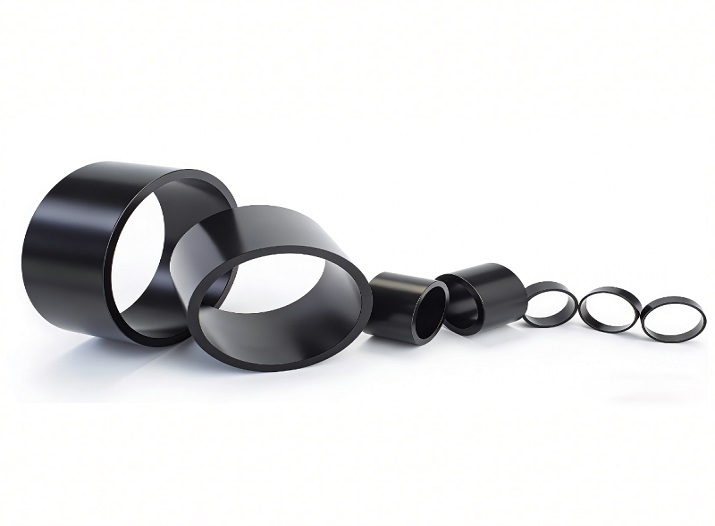
Designing high-efficiency BLDC motors demands precise BLDC motor magnets that balance performance, reliability, and cost. Engineers often face a critical decision early in development: whether to select bonded NdFeB or hard ferrite magnets — two distinct material families with fundamentally different trade-offs. This choice directly impacts motor size, torque density, thermal behavior, manufacturability, and total cost of ownership. Misalignment between magnet selection and application requirements can lead to over-engineering, unnecessary expense, or compromised efficiency — especially in space-constrained, high-performance applications like automotive components and industrial automation equipment.
Overview
The comparison between bonded NdFeB and hard ferrite magnets is not about declaring one ‘superior’ — it’s about matching material capabilities to functional and economic constraints. Both magnet types are validated for use in BLDC motor magnets, but their suitability depends on how design priorities align with inherent material properties. With bonded ndfeb vs ferrite magnets being a frequent point of evaluation during motor magnet selection, this guide provides an engineering-first framework grounded exclusively in verified specifications and real-world application scope.
Material Comparison
Bonded NdFeB Magnet and Hard Ferrite Magnet differ at the structural and compositional level — resulting in divergent magnetic, mechanical, and environmental behaviors.
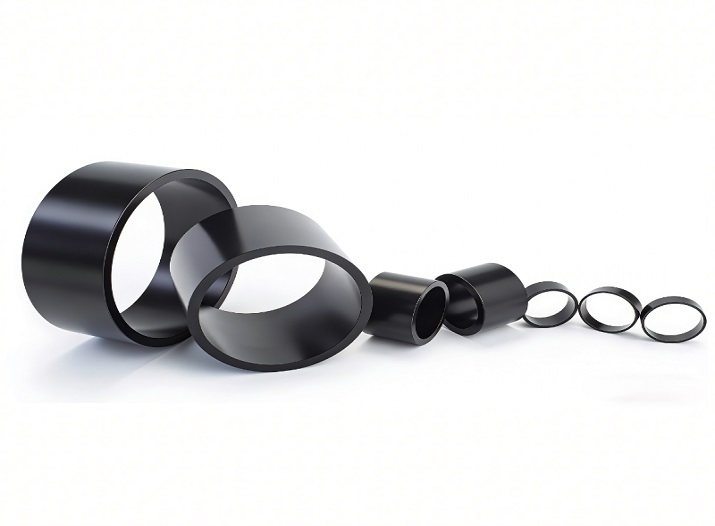
- Bonded NdFeB Magnet: A composite of neodymium-iron-boron powder and polymer binder, offering High Magnetic Strength, Complex Shape Capability, High Dimensional Accuracy, and Good Corrosion Resistance. Its isotropic nature enables net-shape manufacturing of intricate geometries — ideal for segmented rotors, multi-pole configurations, and tight-tolerance assemblies used in compact BLDC motor design.
- Hard Ferrite Magnet: A ceramic sintered material composed primarily of strontium or barium ferrite. It delivers Low Material Cost, Excellent Corrosion Resistance, Good Temperature Stability, and Long Service Life. While its magnetic strength is lower than bonded NdFeB, its stability across wide temperature ranges and resistance to demagnetization under thermal stress make it highly dependable in continuous-duty applications.
Performance Comparison
Performance differences manifest most clearly in three key areas relevant to electric motor magnets:
Magnetic Output & Motor Size
Bonded NdFeB magnets provide higher magnetic energy density. This enables engineers to achieve equivalent torque output in smaller rotor volumes — a decisive advantage in automotive motors, cooling fans, and home appliances where packaging space is constrained. Their High Magnetic Strength supports higher power-to-weight ratios without sacrificing efficiency.
Thermal & Environmental Behavior
Hard ferrite magnets excel in environments where long-term thermal exposure is expected. Their Good Temperature Stability ensures consistent flux output across operating ranges common in industrial motors and water pumps. Meanwhile, bonded NdFeB offers Good Corrosion Resistance — sufficient for sealed or coated motor assemblies — but does not match the inherent passivity of ferrite in unsealed or humid conditions.
Precision & Integration
For advanced BLDC motor design, dimensional fidelity matters. Bonded NdFeB’s High Dimensional Accuracy allows direct integration into rotor cores without secondary machining — reducing assembly complexity and enhancing repeatability. Hard ferrite magnets typically require grinding or bonding steps to meet tight tolerances, adding process steps and cost variability.
Cost and Manufacturing Considerations
From a procurement perspective, motor magnet manufacturer engagement must account for both unit cost and system-level economics.
- Bonded NdFeB carries a higher base material cost but may reduce total motor cost by enabling smaller stators, fewer copper turns, and simplified thermal management — especially in high-volume automotive and industrial automation equipment programs.
- Hard Ferrite offers Low Material Cost and high batch consistency, making it economical for high-volume DC motors, cooling fans, and general-purpose industrial motors where absolute miniaturization isn’t required.
Both materials support OEM Service and Custom Magnet Design, ensuring alignment with proprietary rotor architectures, pole counts, and mounting interfaces. Neither requires special handling during assembly — simplifying supply chain logistics.
Best Applications for Each Option
Selection should be driven by application scenario — not just magnet type.
Choose Bonded NdFeB Magnet When:
- Designing compact, high-torque BLDC motors for automotive components (e.g., EPS, HVAC blowers) or portable industrial automation equipment;
- Requiring complex geometries (e.g., arc segments with chamfers, multi-layer poles, integrated mounting features);
- Targeting high efficiency and power density in space-limited environments like home appliances and cooling fans;
- Needing repeatable dimensional control for automated rotor assembly lines.
Our Bonded NdFeB Magnet series is engineered specifically for these demands — delivering High Magnetic Strength, Complex Shape Capability, and High Precision Manufacturing, and is suitable for BLDC motors and automotive applications.
Choose Hard Ferrite Magnet When:
- Optimizing for lifecycle cost in industrial motors, water pumps, or large-volume cooling fans;
- Operating in thermally stable environments where long-term flux retention is prioritized over peak power;
- Corrosion exposure is severe and coating options are limited;
- Design schedules favor proven, widely available material solutions with minimal qualification overhead.
Which One Should You Choose?
The optimal motor magnet selection emerges from cross-functional alignment — not isolated material specs. Engineers should ask:
- What is the target motor size and torque density requirement?
- What are the thermal and environmental conditions across the full operational envelope?
- Does the rotor geometry benefit from net-shape capability — or is standard block geometry sufficient?
- Is the project volume high enough to justify upfront tooling for bonded NdFeB, or does ferrite’s plug-and-play scalability better suit production timelines?
There is no universal answer — but there is a repeatable engineering process. Both magnet types fall under the product category Permanent Magnets > Motor Magnets, and both are rigorously qualified for the defined application scope: BLDC Motors, DC Motors, Automotive Motors, Industrial Motors, Cooling Fans, and Pumps.
FAQ
Q: Which magnet is better for BLDC motors, bonded NdFeB or ferrite?
A: Bonded NdFeB magnets generally provide higher magnetic strength and compact motor designs, while ferrite magnets offer lower cost and excellent corrosion resistance.
Q: Why are bonded NdFeB magnets commonly used in compact motors?
A: Their higher magnetic energy density allows engineers to achieve higher torque and efficiency in smaller motor designs.
Q: Are ferrite magnets suitable for industrial motors?
A: Yes. Ferrite magnets are widely used in industrial motors, fans, and pumps where cost efficiency and long-term stability are important.
Q: How do engineers choose between bonded NdFeB and ferrite magnets?
A: The decision depends on motor size, torque requirements, efficiency targets, operating temperature, and project budget.
Conclusion
Selecting the right magnet for BLDC motors hinges on disciplined trade-off analysis — not assumptions about material hierarchy. Bonded NdFeB excels where BLDC motor magnets must deliver maximum strength in minimal volume and precision geometry, while hard ferrite remains indispensable where ferrite magnet for motor applications prioritize durability, thermal resilience, and cost predictability. Both options are fully supported under Permanent Magnets > Motor Magnets, with OEM service and custom design capabilities aligned to real-world scenarios: BLDC Motors, Industrial Motors, Automotive Components, Cooling Fans, Water Pumps, Home Appliances, and Industrial Automation Equipment. Contact our engineering team to discuss your application requirements.