


Understanding the Selection Challenge
As automotive sensor systems evolve toward higher resolution, miniaturization, and extended thermal reliability—especially in ADAS, electric powertrain monitoring, and brake-by-wire architectures—engineers face a critical materials selection challenge: identifying an injection magnet that delivers consistent magnetic performance within tight dimensional tolerances, survives under-hood thermal cycling, and integrates seamlessly into high-volume automated assembly. Traditional sintered NdFeB magnets often lack the geometric flexibility required for multi-pole rotor rings or thin-walled Hall effect sensor targets; meanwhile, ferrites fall short on energy density and signal-to-noise ratio in precision electronic components. This is where the engineered capabilities of injection molded magnet technology become indispensable—not as a compromise, but as a purpose-built solution.
Key Evaluation Criteria
1. Magnetic Performance Matched to Application Duty Cycle
Automotive sensors—including ABS wheel speed sensors and Hall effect position sensors—require predictable flux density at air gaps ranging from 0.3 mm to 2.5 mm. The bonded NdFeB injection magnet grades offered by Nibboh span a maximum energy product range of 0.55–8.0 MGOe (4.4–64 kJ/m³), enabling precise grade selection based on signal amplitude, temperature stability, and sensing distance requirements. For instance, TNMI-0.6 provides cost-effective magnetic output for low-resolution encoders, while TNMI-8.0A supports high-fidelity angular measurement in EPS motor feedback systems where field linearity and repeatability are non-negotiable.
2. Thermal Stability Under Real-World Conditions
Under-hood environments routinely exceed 150°C during sustained operation. With a heat deflection temperature of 130–220°C, injection molded bonded NdFeB maintains dimensional integrity and magnetic alignment across this range—critical for maintaining sensor accuracy over vehicle lifetime. Unlike compression-molded alternatives, injection molding ensures uniform polymer binder distribution, reducing localized thermal expansion mismatch between magnet and housing.
3. Dimensional Fidelity and Geometric Complexity
Precision electronic components—such as those in micro motors and optical encoders—demand sub-0.05 mm tolerance consistency across thousands of units. Injection molding enables net-shape production of multi-pole rings, segmented arcs, and asymmetric geometries with integrated mounting features—eliminating secondary machining and reducing assembly steps. This directly supports design for manufacturability (DFM) goals without sacrificing magnetic circuit efficiency.
4. Environmental Resilience
In sealed automotive modules exposed to humidity gradients and condensation cycles, water absorption can degrade long-term magnetic stability. At just 0.01–0.05%, the moisture uptake of these injection magnets is among the lowest in polymer-bonded permanent magnet classes—ensuring stable remanence and coercivity even after accelerated aging per ISO 16750-4.
Common Mistakes Buyers Make
- Over-specifying grade without validating application need: Selecting TNMI-8.0A for a basic ABS sensor adds unnecessary cost without improving functional performance—TNMI-2.0 or TNMI-4.0 often deliver optimal balance of signal strength and thermal margin.
- Ignoring density variation in design validation: With a density range of 3.6–5.2 g/cm³, part mass and inertia calculations must reference the selected grade’s actual density—not an average value—to avoid dynamic imbalance in rotating encoder assemblies.
- Assuming all injection magnets behave identically across suppliers: Binder chemistry, particle size distribution, and molding process control significantly affect magnetic orientation uniformity. Only certified injection magnet manufacturers with full traceability to raw material batches ensure lot-to-lot consistency required for automotive PPAP submissions.
Recommended Solution
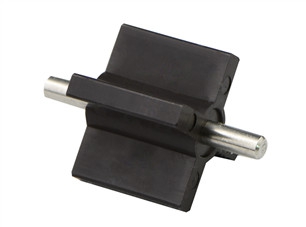
For engineers designing next-generation automotive sensors and precision electronic components, the Injection Magnet series offers a technically grounded, application-aligned solution. Built from injection molded bonded NdFeB, it is available in eight standardized grades—TNMI-0.6, TNMI-1.7, TNMI-2.0, TNMI-4.0, TNMI-5.0, TNMI-6.0, TNMI-8.0, and TNMI-8.0A—each validated for use in automotive sensor magnet applications such as Hall effect sensors, ABS sensors, and micro motor rotors, as well as precision electronic magnet roles in encoders and industrial automation equipment. Its combination of 0.55–8.0 MGOe maximum energy product, 3.6–5.2 g/cm³ density, 130–220°C heat deflection temperature, and 0.01–0.05% water absorption makes it uniquely suited to meet 2026 design requirements for reliability, miniaturization, and scalability.

FAQ
Q: What are injection magnets used for?
A: Injection magnets are commonly used in automotive sensors, precision electronic components, micro motors, encoders, and industrial automation systems where complex shapes and dimensional accuracy are required.
Q: What are the advantages of injection molded magnets?
A: Injection molded magnets offer excellent dimensional consistency, complex shape capability, high production efficiency, and stable magnetic performance for mass production.
Q: Which industries commonly use injection magnets?
A: They are widely used in automotive electronics, sensor systems, consumer electronics, office equipment, industrial automation, and precision motors.
Q: Does Nibboh provide customized injection magnets?
A: Yes. Nibboh provides OEM and customized injection molded bonded NdFeB magnets based on customer drawings, magnetic performance requirements, and application needs.
Conclusion
Selecting the right injection magnet for automotive sensors and precision electronic components in 2026 demands rigorous attention to grade-specific magnetic output, thermal resilience, geometric fidelity, and environmental stability—not generic material labels. Engineers should align grade selection (e.g., TNMI-4.0 vs. TNMI-8.0A) with actual signal-to-noise and duty-cycle requirements, validate density assumptions in dynamic modeling, and partner with an injection magnet manufacturer capable of full traceability and automotive-grade process control. The bonded NdFeB injection magnet platform, with its documented 0.55–8.0 MGOe, 130–220°C heat deflection temperature, and ultra-low water absorption, remains the most versatile and scalable solution for high-accuracy, high-volume magnetic sensing and actuation. Contact our engineering team to discuss your application requirements.