


A flexible magnetic strip is only one part of a refrigerated door seal. The strip’s magnetic behavior, the gasket profile, the steel counterface, the door’s alignment, and the compression of the soft sealing surfaces all interact. A magnet that looks strong on a bench may still produce uneven contact at a corner—or an opening force that is wrong for the appliance.
For OEM and ODM teams, the useful question is not simply “Which rubber magnet grade has the highest value?” It is “What must the complete door-and-gasket assembly do, under which geometry and operating conditions, and what evidence will prove it?”
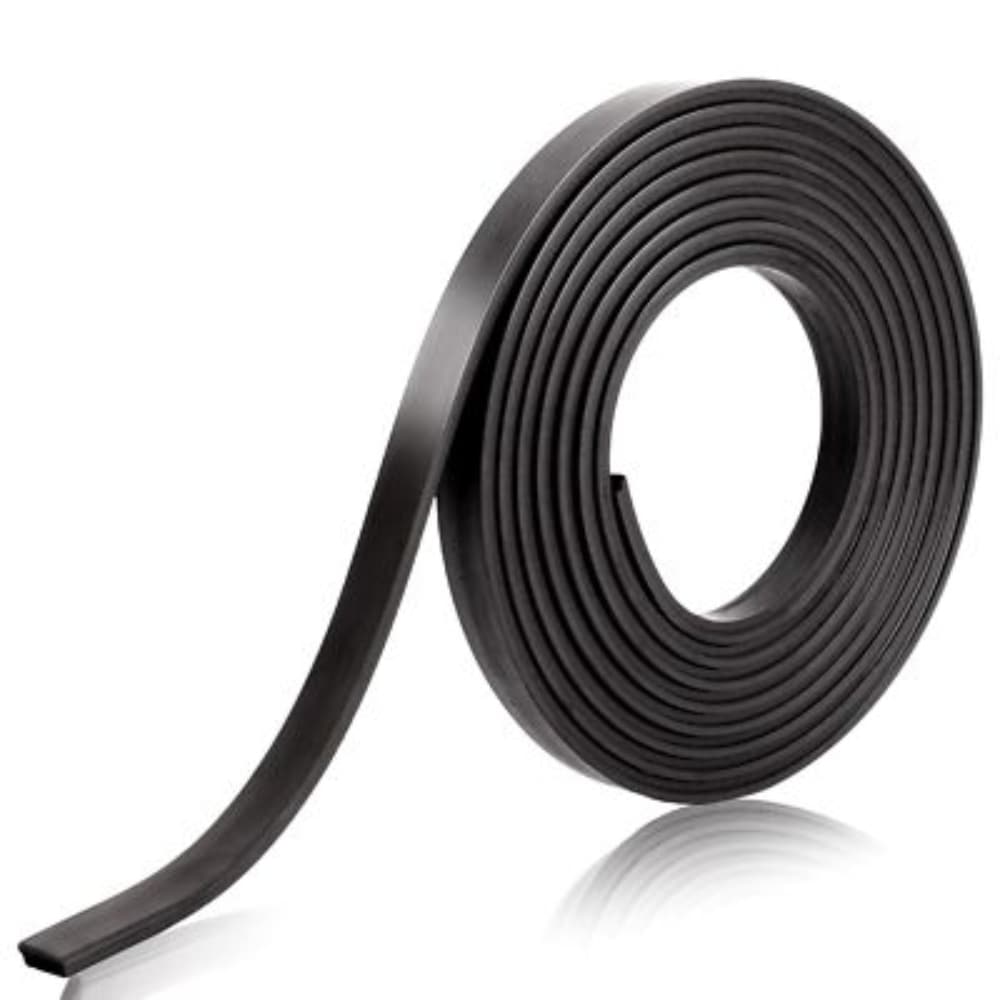
Product image from Nibboh’s Flexible Magnet page (official product-page gallery). It shows a coil of flexible magnet strip, a material example relevant to the insert discussed here; it is not a completed refrigerator gasket, a specific qualified appliance component, or evidence of fit or performance in any refrigerator.
Treat the seal as a system, not a strip
A magnetic refrigerator gasket commonly combines a flexible sealing profile with an embedded magnetic strip. The strip attracts the cabinet’s steel surface, while the profile must deform to close the interface around the door perimeter. A 2021 review of refrigerator gaskets describes this magnetic-strip-and-flexible-profile arrangement and notes that leakage depends on gaps at the contact interfaces, pressure conditions, and flow behavior [2]. A 2023 experimental study used tracer gas to measure gasket “breathing” under different refrigerator operating conditions and found, in its test setup, that increased magnetic attraction reduced the infiltration gap [3]. Its numerical results belong to that particular geometry and test system; they should not be converted into a universal OEM limit.
This distinction matters for procurement. A magnet-property table can help compare candidate strips, but it cannot by itself specify door closing effort, perimeter contact, air leakage, condensation, frost, or appliance energy use. Those are assembly- or appliance-level outcomes.
Choose the appliance and mounting interface first
Begin by identifying the product and door configuration: household refrigerator, upright freezer, wine cabinet, refrigerated display cabinet, or another application. Record whether the door is vertical or horizontal, how it is supported, where the gasket engages the cabinet, what steel surface it closes against, and how much misalignment or local gap the assembly must tolerate. The door’s orientation and weight can change the role of magnetic attraction; refrigerator-gasket literature distinguishes vertical-door arrangements from horizontal freezers, where door gravity can contribute to closure [2, 4]. Do not transfer one product’s closing-force target to a different cabinet style without testing.
The assembly drawing should show the gasket cross-section and the magnet pocket, the retaining slot or attachment geometry, the sealing lips or chambers, the steel contact face, the corner and joint treatment, and the installed compression range. Specify which company owns each component: the magnet-strip supplier, gasket extruder/converter, door manufacturer, or appliance OEM. If the magnet supplier is not the complete gasket supplier, the boundary between insert and gasket needs to be explicit.
Specify the magnetic strip beyond “flexible ferrite”
A useful strip specification includes:
- Cross-section and dimensions: width, thickness, profile, length, tolerance, and how straightness or curl will be checked.
- Material and forming route: the agreed grade and whether the quote is for extruded, calendered, or another listed form.
- Magnetization: direction, number and position of poles or pole pitch if controlled, face orientation, polarity convention, and inspection method.
- Mechanical interface: fit within the gasket pocket, retention method, permissible gaps, and how joints or corners preserve continuity.
- Operating conditions: temperature range, exposure, compression/handling conditions, and the intended steel counterface.
- Acceptance evidence: which dimensions, magnetic properties, and assembly-level forces are measured, under what fixture and conditions.
A K&J Magnetics field investigation of a salvaged refrigerator-seal strip observed a multi-region pole pattern in the samples it examined [5]. This is not proof that all refrigerator seals use the same pattern; it is a practical reason to call out the required magnetization pattern rather than leaving “magnetized strip” undefined. Where the pole pattern is critical, request a magnetic-viewing image or field map from a representative sample and tie the approved pattern to the drawing revision.
The public Nibboh flexible-magnet page describes ferrite powder combined with synthetic rubber, lists extrusion and calendering among forming routes, offers roll/sheet/custom forms, names door and window sealing strips as an application, and publishes a table of eight grade/type rows with Br, Hcb, Hcj and BHmax values [1]. That page can support an inquiry about flexible magnetic material. It does not document a complete refrigerator gasket, a particular pole pattern, a gasket extrusion/thermal-welding process, a customer door interface, an OEM certification, or measured closure and leakage performance. It also does not say that the listed magnetic figures are a complete acceptance plan for a finished seal.
Match magnetic attraction to profile compliance
Closing force must be considered alongside gasket stiffness and geometry. If attraction is too low for the defined steel surface and installation gap, parts of the perimeter may not seat reliably. If attraction is unnecessarily high, the door may be harder to open or the gasket may be compressed differently than intended. A magnet may also show a satisfactory pull value against a thick flat coupon but behave differently when the real door has a coating, curved profile, thinner steel, a local gap, or a tilted closing path.
For an engineering evaluation, map force against separation and compression rather than collecting a single “pull force” number. Use the intended steel grade, thickness, coating and contact geometry. Test straight sections and corners, and capture both initial closing/holding behavior and opening effort. Record the pull angle, speed, fixture, contact area, gap, temperature, and location along the perimeter. Eriez’s guidance for industrial separator magnets—not refrigerator gaskets—shows why pull-test results can change with the test piece and its geometry; comparable results require a defined, repeatable setup [6]. The lesson transfers as a measurement discipline, not as a gasket-specific standard.
The door seal itself also has mechanical properties: profile dimensions, local compression, resilience after release, and retention of the magnetic insert in its pocket. A 2024 Six Sigma case study on refrigerator-door sealing examined profile/channel variation and measured retention force in a specific production line [4]. The study is useful as an example of why process and assembly measurements matter, but its numerical limits apply only to that case. For an OEM project, set limits from the actual design, risk analysis and validation—not by copying another manufacturer’s result.
Use a staged validation plan
1. Material and incoming-strip checks. Agree what material-property values are required and how the supplier will report them. Confirm the delivered form, dimensions, magnetization orientation, and representative field/pole pattern. Define whether a property value describes a material grade, a sample, or a delivered lot. Nibboh’s listed Br/Hcb/Hcj/BHmax values are published product data; buyers should still agree lot-level evidence and test conditions for the project [1].
2. Gasket subassembly checks. Fit the approved strip into the intended profile and verify retention, position, continuity, and dimensional fit. Check that the strip is not twisted, displaced, locally exposed, or interrupted at the corners or joins. If the gasket supplier changes profile tooling, insert dimensions, joining process, or material, treat it as a controlled change and repeat the relevant tests.
3. Door-assembly checks. On a representative door and cabinet frame, measure closing/holding force and opening force at defined locations and gaps. Verify continuous contact around the perimeter, including corners and areas affected by hinge or frame tolerances. Measure leakage using an agreed method where sealing performance is critical; a paper-strip check may be a quick screening step, but it is not a substitute for a quantified OEM test. A tracer-gas method has been used in published refrigerator-gasket research to measure moisture-air infiltration under dynamic operation [2, 3].
4. Durability and environmental checks. Define door-cycle count, compression dwell, temperature/humidity exposure, cleaning chemicals if relevant, and post-aging measurements. After the conditioning sequence, repeat the force and leakage checks and inspect for loss of profile recovery, insert movement, cracks, corner separation, or changes in the magnetic field. Do not assume that a material’s nominal room-temperature table proves performance after the product’s complete operating cycle.
5. Appliance-level performance. For household and similar refrigeration appliances, IEC 62552-3:2015+AMD1:2020+AMD2:2025 covers energy-consumption and volume test methods at appliance level [7]. For commercial refrigerated display cabinets, ISO 23953-2:2023 specifies performance requirements and test conditions/methods for the cabinet [8]. These standards help define system-level evaluation where applicable; neither is a stand-alone flexible-strip pull-force, gasket-material, leak-test, or supplier-certification standard. A passing material test cannot replace the appliance’s applicable regulatory or OEM validation.
Put supplier evidence in the RFQ
A strong RFQ separates insert requirements from gasket and appliance requirements. Attach the controlled cross-section and magnet-strip drawing; state the counterface and target compression/gap range; identify the required magnetization and polarity; list the incoming checks and the actual assembly-level tests; and define who supplies the finished gasket, who assembles it to the door, and who owns appliance testing.
Request a first-article sample made to the proposed production configuration, a dimensional report, lot identification, agreed magnetic-property evidence, a repeatable field/pole-pattern check if relevant, and a written process-change notification covering material, forming, magnetization, profile tooling and joining. If an OEM requires food-contact, fire, electrical, or other regulatory evidence, name the exact requirement and product scope and request the matching certificate or test record. Do not infer a certification from a different supplier’s webpage or from a general flexible-magnet product page.
For supplier discussions, Nibboh’s public page can be used to identify a flexible ferrite material family and inquiry fields such as shape, width, thickness, length, grade, surface film/coating, adhesive, operating conditions and order quantity [1]. It should not be presented as proof that Nibboh supplies a complete gasket, has qualified a particular refrigerator model, or has validated closure force, leakage or energy performance. Those claims require project-specific evidence from the responsible supplier and OEM test program.
The shortest path to a useful sample
Send the magnet-strip drawing and the gasket cross-section together, not separately. Include the intended steel surface, door orientation, allowed gap and compression, target opening/holding behavior, operating envelope, and the method by which the final seal will be judged. Then ask for a sample and evidence package that separates strip properties from gasket retention, door-level sealing and whole-appliance performance. That is how a flexible magnet becomes a controlled OEM component instead of an isolated catalogue line.
References
- Nibboh — Flexible Magnet. Public page with material/form options and listed grade data; not complete-gasket qualification evidence.
- Guoqiang Liu, Gang Yan and Jianlin Yu, “A review of refrigerator gasket: Development trend, heat and mass transfer characteristics, structure and material optimization”, Renewable and Sustainable Energy Reviews, 2021.
- Guoqiang Liu et al., “Study of breathing behavior and its heat load for a refrigerator through the gasket”, International Communications in Heat and Mass Transfer, 2023. Specific experimental setup; do not generalize its values as OEM limits.
- Ioana-Cătălina Enache, Oana Roxana Chivu and Florin-Felix Raduică, “Eliminating Scraps in Refrigerator Door Sealing—A Six Sigma Case Study”, Processes, 2024. Single production-line case study.
- K&J Magnetics — “Re-Magnetizing Refrigerator Seals”. Retailer’s investigation of salvaged seal material; observations are sample-specific.
- Eriez — “How to Conduct a Magnet Pull Test”. Industrial separator-magnet guidance; cited only for repeatable test-fixture discipline, not as a gasket test standard.
- IEC 62552-3:2015+AMD1:2020+AMD2:2025 CSV, household and similar refrigerating-appliance energy-consumption and volume test methods.
- ISO 23953-2:2023, commercial refrigerated display cabinets—performance requirements and test conditions/methods.
- Nibboh — Flexible Magnet, source page for the product-gallery image of a flexible magnet strip; the image is not a complete refrigerator gasket or qualification evidence.