


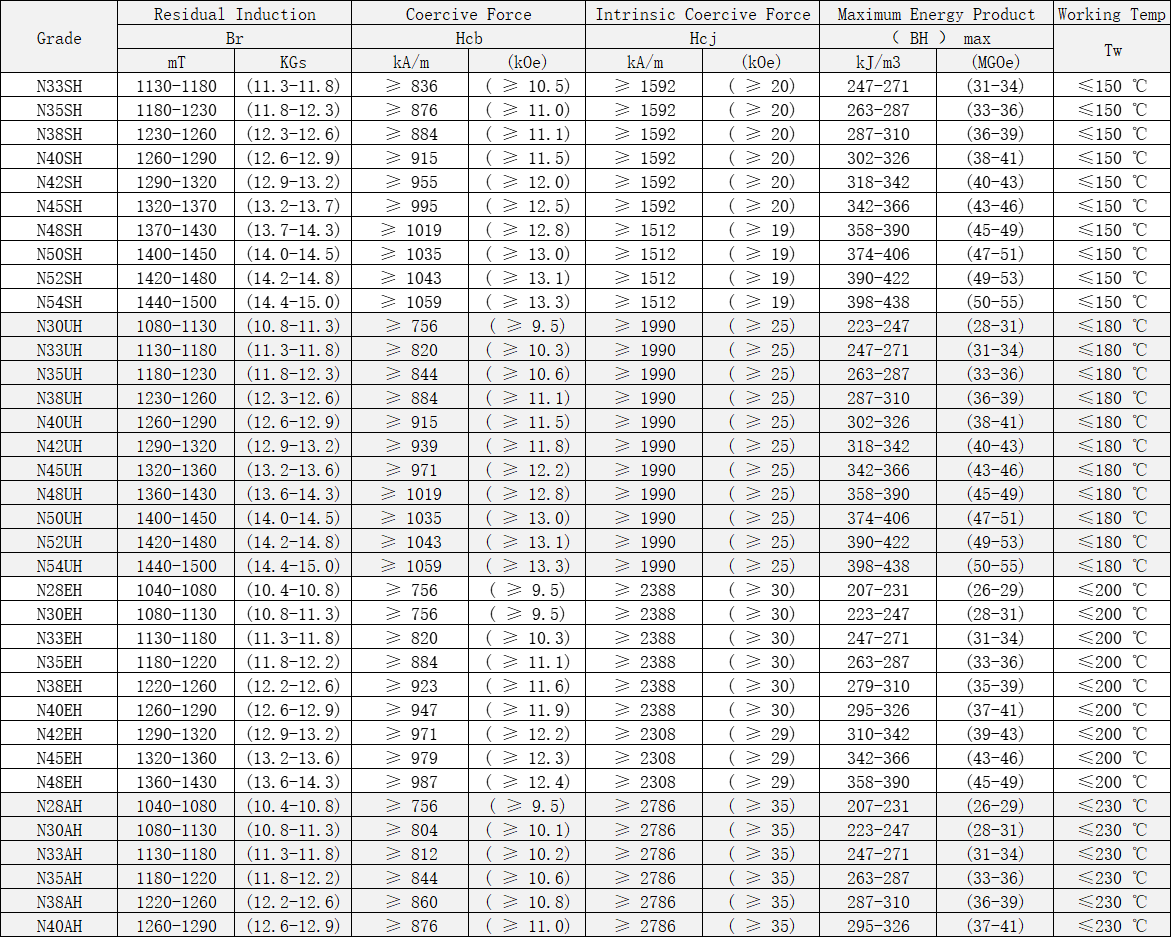
Summary: Nibboh’s published technical overview lists four N35 sintered NdFeB grades with different coercivity thresholds and maximum working-temperature fields. Use those values to screen candidate grades, then review the actual magnet geometry, magnetic circuit, coating, tolerances, and assembly temperature.
Cover: Nibboh’s sintered NdFeB magnet page publishes the grade table for N35SH, N35UH, N35EH, and N35AH.
When a sintered NdFeB magnet will see elevated temperature, the letter suffix is not decoration. It changes the published coercivity and maximum working-temperature field in the grade table. Our product data lists four useful N35 comparison points: N35SH, N35UH, N35EH and N35AH.
The practical way to compare them is to start with the operating-temperature requirement, then check coercivity and magnetic output. Do not choose from the grade name alone. Confirm the magnet’s geometry, magnetic circuit, coating, tolerances and actual assembly temperature with the drawing and application data.
The four N35 grades at a glance
The following values are transcribed from our published technical overview. They are published nameplate ranges and limits, not measurements from a particular customer part or a guarantee of complete system performance.
| Grade | Residual induction Br | Coercive force Hcb | Intrinsic coercive force Hcj | Maximum energy product (BH)max | Published maximum working temperature Tw |
|---|---|---|---|---|---|
| N35SH | 1180–1230 mT (11.8–12.3 kGs) | ≥876 kA/m (≥11.0 kOe) | ≥1592 kA/m (≥20 kOe) | 263–287 kJ/m³ (33–36 MGOe) | ≤150°C |
| N35UH | 1180–1230 mT (11.8–12.3 kGs) | ≥844 kA/m (≥10.6 kOe) | ≥1990 kA/m (≥25 kOe) | 263–287 kJ/m³ (33–36 MGOe) | ≤180°C |
| N35EH | 1180–1220 mT (11.8–12.2 kGs) | ≥884 kA/m (≥11.1 kOe) | ≥2388 kA/m (≥30 kOe) | 263–287 kJ/m³ (33–36 MGOe) | ≤200°C |
| N35AH | 1180–1220 mT (11.8–12.2 kGs) | ≥844 kA/m (≥10.6 kOe) | ≥2786 kA/m (≥35 kOe) | 263–287 kJ/m³ (33–36 MGOe) | ≤230°C |
The table shows the main pattern clearly: the four grades publish the same (BH)max range, while the higher-temperature suffixes publish higher Hcj thresholds and higher Tw limits. N35SH and N35UH publish the same Br range; N35EH and N35AH publish a slightly narrower Br range. Hcb is not a simple upward ladder across the four rows, so it should not be inferred from the suffix or substituted for Hcj.
What the suffix comparison can—and cannot—tell you
For the N35 rows on our table, the suffix is most useful as a screening label for thermal margin and intrinsic coercivity. The published Tw values progress from ≤150°C for N35SH to ≤180°C for N35UH, ≤200°C for N35EH and ≤230°C for N35AH. The published Hcj thresholds progress from ≥1592 kA/m to ≥1990 kA/m, ≥2388 kA/m and ≥2786 kA/m, respectively.
Those are catalog fields. Tw is not a statement that every finished motor, sensor or assembly can be operated continuously at that temperature. Our product page asks customers to provide the intended operating temperature and coating requirements for project-specific quotation. We therefore treat Tw as a grade-screening limit, not as a complete system validation result.
Likewise, the table does not establish efficiency, torque, field strength at a specified air gap, lifetime, runtime, compatibility with a particular motor, or certification for a finished assembly. Those outcomes depend on the magnet dimensions, magnetization direction, magnetic circuit, mechanical retention, nearby materials and the application’s thermal profile.
A bounded selection decision for an RFQ
Use this sequence when you send us a drawing or inquiry:
- Record the actual temperature condition. State the expected magnet temperature, not only ambient temperature. If the value is still being estimated, identify the estimate and the heat sources that may raise it.
- Use Tw to screen candidate grades. N35SH is the ≤150°C published option in this four-grade comparison; N35UH, N35EH and N35AH publish ≤180°C, ≤200°C and ≤230°C, respectively. Keep design margin between the estimated operating condition and the catalog limit; the required margin is an engineering decision, not a value supplied by this table.
- Check Hcj when irreversible-demagnetization resistance matters. The published Hcj thresholds are ≥1592, ≥1990, ≥2388 and ≥2786 kA/m for N35SH, N35UH, N35EH and N35AH. Do not treat a higher Hcj value as proof of a specific motor or sensor result without checking the magnetic circuit.
- Confirm the output and geometry separately. All four rows publish 263–287 kJ/m³ (33–36 MGOe) for (BH)max, but the final part still needs its dimensions, tolerances, magnetization direction and coating defined. Our sintered NdFeB page explains that these magnets can be produced in different shapes and sizes and commonly receive anti-corrosion coatings such as zinc, nickel-copper-nickel, chromium or epoxy.
- Request engineering review before release. Send the drawing if available, quantity, operating temperature, coating requirement and target magnetic performance through our contact page. If the grade is not yet selected, describe the application and we can review the candidate against the stated conditions.
N35SH, N35UH, N35EH or N35AH?
A concise, table-bounded answer is:
- N35SH: start here when the published ≤150°C Tw class fits the application and the ≥1592 kA/m Hcj threshold is adequate for the magnetic circuit.
- N35UH: evaluate when the published ≤180°C class is needed, while retaining the same published Br and (BH)max ranges shown for N35SH.
- N35EH: evaluate when the published ≤200°C class and ≥2388 kA/m Hcj threshold are relevant; its published Br range is 1180–1220 mT.
- N35AH: evaluate when the published ≤230°C class and ≥2786 kA/m Hcj threshold are required by the design review; its published Br range is also 1180–1220 mT.
This is a candidate-screening decision, not a substitute for a thermal-demagnetization analysis or a sample approval. A grade with a higher published Tw value is not automatically the best choice if the geometry, coating, magnetization or magnetic circuit is unsuitable.
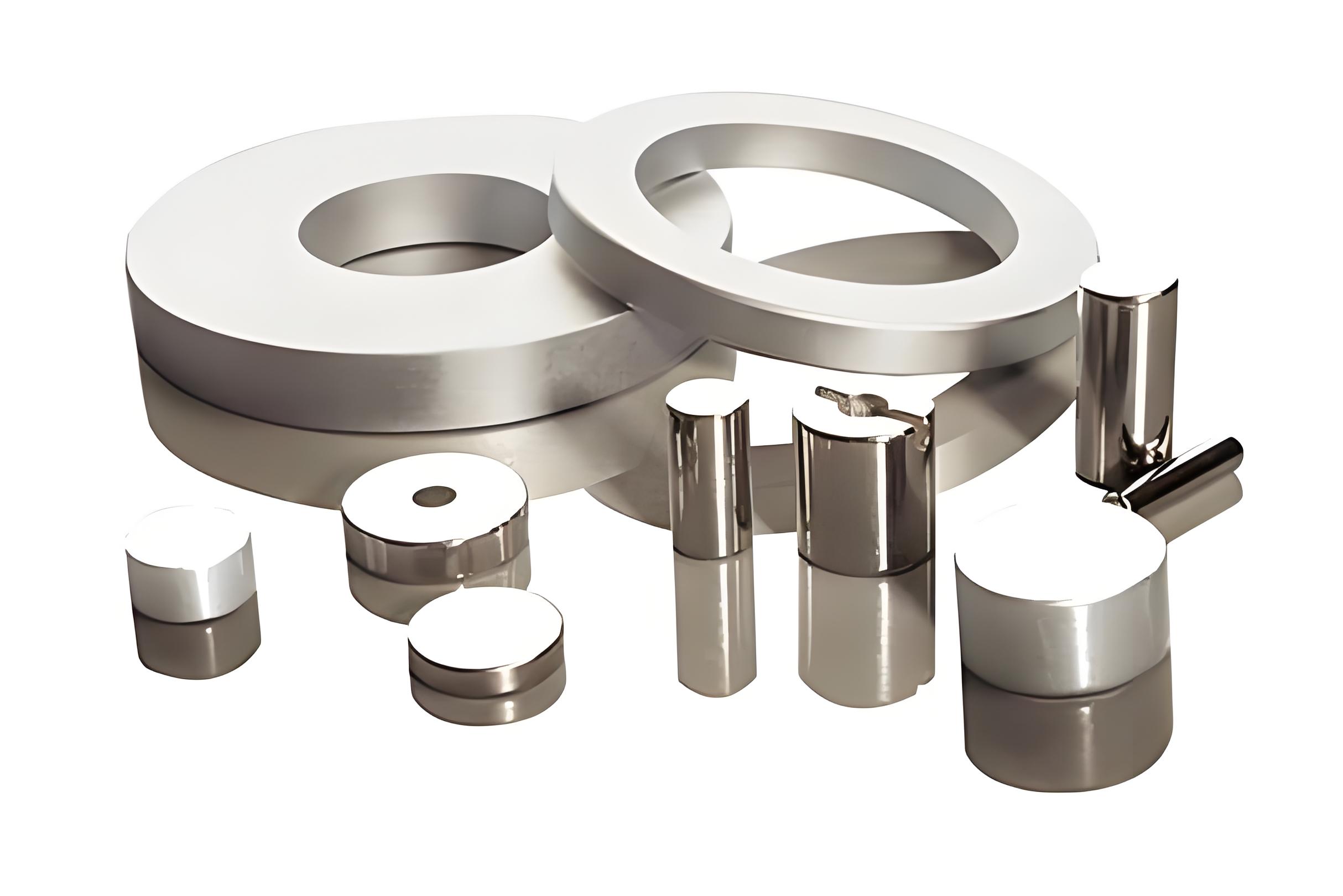
Our sintered NdFeB magnet page shows an assortment of ring, disc, and cylindrical magnet forms. Final shape and dimensions should be specified for the application.
What to include in your request
For a useful review, include the magnet grade under consideration, finished dimensions and tolerances, magnetization direction, coating, quantity, expected magnet temperature, surrounding materials and the required delivery destination. A drawing is especially useful when the magnet is part of a motor, sensor or other assembly.
We provide the published grade data as a starting point. We do not infer finished-system efficiency, lifetime, runtime, compatibility or safety from a grade-table row. Those claims require application-specific evidence and agreed test conditions.
Discuss your application with Nibboh or review the complete Sintered NdFeB Magnet technical page before requesting a quote.