


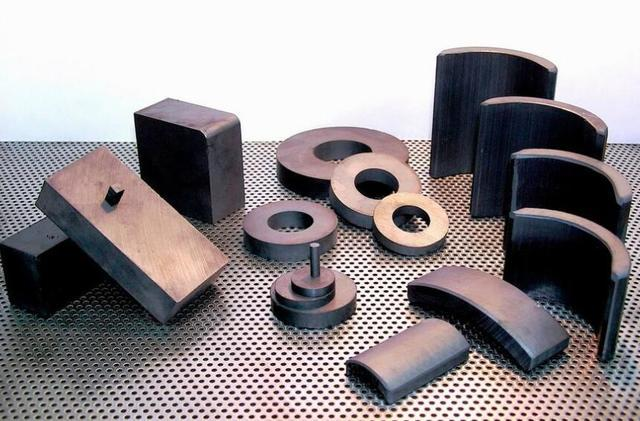
Introduction: What are Ceramic Magnets?
Ceramic magnets, also widely known as ferrite magnets, are a class of permanent magnets manufactured from a sintered composite of iron oxide (Fe₂O₃) combined with either strontium carbonate (SrCO₃) or barium carbonate (BaCO₃). The result is a hard, dark-grey ceramic material—chemically expressed as SrFe₁₂O₁₉ (strontium ferrite) or BaFe₁₂O₁₉ (barium ferrite)—that retains a stable magnetic field for decades without an external power source.
First developed by Philips’ Physics Laboratory in the Netherlands in the early 1950s, ceramic magnets revolutionized the magnet industry by offering a low-cost, corrosion-resistant alternative to costly metallic alloy magnets. Today, despite the rise of high-performance rare-earth magnets, ferrite magnets still account for the largest volume of permanent magnet production globally—a testament to their unmatched cost-to-performance ratio.
For engineers, product designers, and industrial buyers evaluating magnetic solutions, understanding ceramic magnets is essential. They remain the default choice for high-volume applications where cost, thermal stability, and corrosion resistance outweigh the need for maximum magnetic strength.
How are Ceramic Magnets Made? The Manufacturing Process
The production of ceramic magnets is a precise powder-metallurgy process that transforms common oxides into a high-performance magnetic material. Below are the key stages.
Raw Material Preparation
The process begins with mixing roughly 80% iron oxide (Fe₂O₃) with 20% strontium or barium carbonate. These powders are blended thoroughly to ensure compositional uniformity.
Calcining
The blended powder is heated in a kiln at temperatures between 1,000 °C and 1,350 °C. During this stage, a solid-state reaction transforms the raw mixture into hard hexagonal ferrite (SrO·6Fe₂O₃ or BaO·6Fe₂O₃)—the phase responsible for the magnetic behavior.
Milling
The calcined material is ball-milled (often wet-milled) into ultra-fine particles—typically less than 1 micron in diameter. Achieving a single magnetic-domain particle size is critical for maximizing coercivity in the finished magnet.
Pressing
The fine ferrite powder is then pressed into the desired shape. There are two principal methods:
- Dry Pressing: Powder is compacted in a die. Faster and cheaper, but yields slightly lower magnetic performance. Often used for isotropic magnets.
- Wet Pressing: A water-based slurry is pressed within a magnetic field that aligns the particles’ easy axis. Produces higher-performing anisotropic magnets but at greater cost.
Sintering
Pressed “green” parts are sintered at approximately 1,100 °C–1,250 °C, fusing particles into a dense ceramic body. Shrinkage of 10–20% occurs during this step, which must be accounted for in tooling design.
Machining
Because sintered ferrite is hard and brittle, final dimensions are achieved using diamond-tool grinding. Tolerances of ±0.1 mm are typical without grinding, and ±0.05 mm or tighter when ground.
Magnetization
Finished parts are exposed to a strong external magnetic field (often via a capacitor-discharge magnetizer), aligning the ferrite domains and producing the final permanent magnet.
Key Properties and Characteristics of Ceramic Magnets
The properties of ceramic magnets make them suitable for an enormous range of applications. Here is what engineers should know.
Magnetic Properties
- Remanence (Br): 2,000–4,000 Gauss (0.2–0.4 T)
- Coercivity (Hc): Moderate to high (1,800–3,200 Oe)—offering strong resistance to demagnetization
- Maximum Energy Product (BHmax): 0–4.0 MGOe, depending on grade
- Curie Temperature: Approximately 460 °C
Physical Properties
- High corrosion resistance: Ceramic magnets do not rust or oxidize and typically require no surface coating, even in humid environments.
- Excellent thermal performance: Continuous operating temperatures up to 250 °C (482 °F) without significant flux loss.
- High electrical resistivity: Ferrite is essentially a non-conductor (>10⁴ Ω·cm), eliminating eddy-current losses in motor and high-frequency applications.
- Brittle and hard: Like most ceramics, they chip and crack easily under impact or tensile load—a critical design consideration.
- Density: ~4.8–5.0 g/cm³, lighter than rare-earth alternatives.
Cost-Effectiveness
Ferrite raw materials—iron oxide and strontium/barium carbonate—are abundant and inexpensive. As a result, ceramic magnets cost roughly 5–10× less per kilogram than neodymium magnets, making them irreplaceable in price-sensitive, high-volume products.
Types and Grades of Ceramic Magnets
Hard Ferrite vs. Soft Ferrite
- Hard ferrites (used as permanent magnets) retain their magnetization indefinitely. These are the materials referred to in this article.
- Soft ferrites are easily magnetized and demagnetized, making them ideal for transformer cores, inductors, and EMI suppression—not for permanent-magnet duty.
Isotropic vs. Anisotropic
- Isotropic ceramic magnets can be magnetized in any direction but produce a comparatively weaker field. Common grade: C1.
- Anisotropic ceramic magnets are oriented during pressing in a magnetic field, yielding much higher remanence and energy product in the preferred direction. Common grades: C5, C7, C8, C8B, C11.
Common Ceramic Magnet Grades
Grade | Type | Br (Gauss) | Hc (Oersted) | BHmax (MGOe) | Max Op. Temp | Typical Use |
C1 | Isotropic | ~2,300 | ~1,860 | ~1.05 | 250 °C | Craft magnets, holding, low-cost assemblies |
C5 (Y30) | Anisotropic | ~3,800 | ~2,400 | ~3.4 | 250 °C | DC motors, loudspeakers, general industrial |
C7 | Anisotropic | ~3,400 | ~3,250 | ~2.75 | 250 °C | High-coercivity motor applications |
C8 (Y30H-1) | Anisotropic | ~3,850 | ~2,950 | ~3.5 | 250 °C | High-performance motors, automotive sensors |
C8B / C11 | Anisotropic | ~4,000+ | ~3,200+ | ~4.0+ | 250 °C | Premium ferrite applications |
Applications of Ceramic Magnets
The applications of ceramic magnets span nearly every modern industry. Their durability, thermal stability, and low cost make them ubiquitous.
Automotive & Industrial Motors
Ferrite arc segments are core components of DC motors used in window lifts, windshield wipers, HVAC blowers, seat adjusters, and starter motors. They also power countless industrial fans, pumps, and stepper motors.
Loudspeakers and Audio Equipment
The dark ring magnet behind nearly every car speaker, home stereo woofer, and PA driver is a ceramic magnet. Their high coercivity and stable field make them ideal for moving-coil transducers.
Magnetic Separators
In mining, recycling, and food processing, ferrite-based separators remove ferrous contaminants from product streams. Their corrosion resistance is essential in wet processing environments.
Sensors and Reed Switches
Ceramic magnets actuate Hall-effect sensors, reed switches, and proximity detectors in automotive, security, and industrial automation systems.
Consumer & Craft Products
Refrigerator magnets, magnetic name badges, whiteboard magnets, toys, and educational kits commonly use low-cost C1 ferrite.
MRI and Medical Applications
While most modern MRI scanners use superconducting electromagnets, low-field open MRI systems historically employed large ceramic magnet arrays due to their stability and lower cost.
Holding and Latching Applications
Door catches, magnetic chucks, tool holders, and cabinet latches frequently use ceramic blocks for their reliability and value.
Ceramic Magnets vs. Neodymium Magnets: A Comparison
The choice between ceramic vs neodymium magnets is one of the most common decisions in magnetic-circuit design. Here’s a side-by-side comparison.
Property | Ceramic (Ferrite) | Neodymium (NdFeB) |
Magnetic Strength (BHmax) | 1.0 – 4.0 MGOe | 30 – 52 MGOe |
Cost | Very low ($) | High ($$$$) |
Max Operating Temp | Up to 250 °C | 80 °C standard, up to 200 °C (high-grade) |
Curie Temperature | ~460 °C | ~310 °C |
Corrosion Resistance | Excellent (no coating required) | Poor (requires Ni, Zn, or epoxy coating) |
Brittleness | Brittle | Brittle |
Electrical Conductivity | Insulator | Conductor |
Density | ~4.9 g/cm³ | ~7.5 g/cm³ |
Supply Chain | Stable (abundant raw materials) | Volatile (rare-earth dependent) |
Best For | Cost-sensitive, high-temp, corrosive environments | Compact, high-strength, performance-critical designs |
Key takeaway: Neodymium delivers up to 10× the energy product, but ceramic magnets win decisively on cost, thermal headroom, and corrosion resistance. For a motor running at 180 °C in a humid pump housing, ferrite is often the only sensible choice.
Conclusion
Ceramic (ferrite) magnets remain one of the most important and versatile materials in modern engineering. They deliver a uniquely balanced combination of cost-effectiveness, thermal stability, corrosion resistance, and electrical insulation—properties that no other permanent magnet family can match at the same price point.
While neodymium magnets dominate where compact, ultra-strong fields are required, ceramic magnets continue to power the everyday world: the motors in your car, the speakers in your home, the sensors in industrial machinery, and the holding magnets on the factory floor. For engineers and industrial buyers, specifying the right grade—C1 for simple isotropic uses, C5 or C8 for performance-critical anisotropic applications—can make the difference between a robust, cost-optimized product and an over-engineered one.