


Abstract / Executive Summary
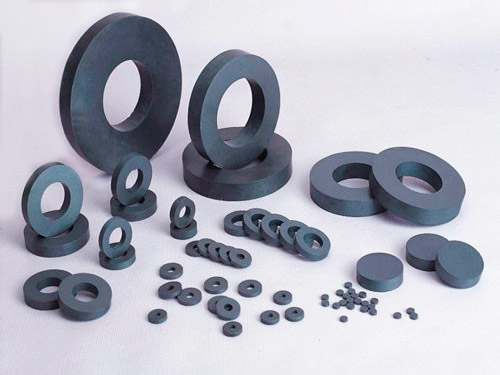
Hard ferrite magnetic materials—also referred to as permanent ferrite magnets or ceramic magnets—are sintered, oxide-based permanent magnets composed predominantly of strontium hexaferrite (SrFe₁₂O₁₉) or barium hexaferrite (BaFe₁₂O₁₉). Belonging to the M-type hexagonal ferrite family with the magnetoplumbite crystal structure, these materials combine high uniaxial magnetocrystalline anisotropy, moderate remanence, and exceptional environmental stability. They are characterised by intrinsic coercivities (HcJ) in the range 200–400 kA/m, energy products ((BH)max) of 1.0–4.5 MGOe (8–36 kJ/m³), and continuous service temperatures up to ~250–300 °C. This article provides a comprehensive technical examination of their definition, composition, manufacturing, fundamental magnetic and physical properties, and principal industrial applications, along with a rigorous comparison against soft ferrite materials.
Introduction: The Foundation of Hard Ferrite Magnetism
Definition
A hard ferrite magnetic material is a ferrimagnetic ceramic compound exhibiting a wide hysteresis loop, high coercivity, and the ability to retain magnetisation in the absence of an external field. By the IEC 60404 family of standards, a magnet qualifies as “hard” when its coercivity Hc exceeds approximately 10 kA/m (≈125 Oe); commercial hard ferrites comfortably exceed 150 kA/m. Functionally, they serve as permanent magnets, distinct from soft ferrites (e.g., MnZn, NiZn spinels) which have low coercivity and are designed for cyclic magnetisation in inductors and transformer cores.
Historical Context
The systematic development of hard hexagonal ferrites was pioneered at the Philips Physics Laboratory (NatLab) in the early 1950s, with J. J. Went, G. W. Rathenau, E. W. Gorter, and J. Smit publishing the foundational characterisation of BaFe₁₂O₁₉ (“Ferroxdure”) in 1952. Subsequent work demonstrated that partial substitution of barium with strontium yielded superior magnetic performance, leading to the commercial dominance of strontium hexaferrite from the late 1960s onward. Today hard ferrites account for an estimated 75–80% of the global permanent-magnet tonnage, despite representing a much smaller share of monetary value compared with rare-earth Nd–Fe–B and Sm–Co magnets.
Chemical Composition and Crystal Structure
Hard ferrites are stoichiometric oxides of the general formula MFe12O19, where M = Sr²⁺, Ba²⁺, or Pb²⁺ (the latter rarely used commercially). The principal raw materials are:
- Iron(III) oxide (Fe₂O₃, hematite)— typically 80–90 wt%, sourced from steel-pickling by-products.
- Strontium carbonate (SrCO₃) or barium carbonate (BaCO₃)— providing the M-site cation.
- Dopants(CaO, SiO₂, La₂O₃, Co₃O₄) — added in ppm-to-percent levels to modify grain growth, coercivity, and temperature stability.
Both SrFe₁₂O₁₉ and BaFe₁₂O₁₉ crystallise in the magnetoplumbite (M-type) hexagonal structure, space group P63/mmc, with lattice parameters a ≈ 5.88 Å and c ≈ 23.05 Å for the strontium phase. The unit cell consists of alternating spinel-like (S) and hexagonal (R) blocks stacked along the c-axis. Fe³⁺ ions occupy five crystallographically distinct sites (12k, 4f1, 4f2, 2a, 2b); the parallel and antiparallel coupling between these sublattices produces the net ferrimagnetic moment. The strong spin-orbit interaction at the trigonal-bipyramidal 2b site is the dominant origin of the large uniaxial magnetocrystalline anisotropy (K1 ≈ 3.3 × 10⁵ J/m³ for SrM at 300 K), which underpins the high coercivity that defines the material as a permanent magnet.
Manufacturing Process: From Raw Materials to Permanent Magnets
Industrial production of hard ferrite magnets follows a classic powder-metallurgy / ceramic-sintering route. Each step exerts a measurable influence on the final magnetic performance.
Calcining (Pre-Firing)
A stoichiometric mixture of Fe₂O₃ and SrCO₃ (or BaCO₃) is homogenised by wet ball-milling, dried, and calcined at 1,150–1,300 °C in air for several hours. The solid-state reaction
SrCO₃ + 6 Fe₂O₃ → SrFe₁₂O₁₉ + CO₂ ↑
forms the M-type hexaferrite phase. Calcining temperature and dwell time control the degree of phase purity, crystallite size, and ultimately the ratio between intrinsic and extrinsic coercivity contributions.
Milling
The friable calcine “clinker” is wet-milled (typically in attrition or vibratory mills) until a median particle size of 0.7–1.0 µm is reached—close to the single-domain critical size for hexaferrite (~1 µm). Fine, narrow particle size distributions are essential to maximise H_cJ; coarser fractions act as multi-domain nucleation sites and degrade coercivity.
Pressing — Isotropic vs. Anisotropic
Compaction can be performed dry (yielding isotropic hard ferrite) or wet, in the presence of a pulsed orienting field of 0.5–1.0 T (yielding anisotropic hard ferrite). In wet pressing, the slurry consists of ferrite particles suspended in water; the field aligns each crystallite’s easy c-axis parallel to the desired magnetisation direction prior to mechanical compaction at 50–200 MPa. The resulting “green” body is dewatered through filter membranes integrated into the die.
Sintering
Green compacts are sintered in air at 1,150–1,250 °C for 1–4 h. Densification is driven by surface-energy reduction; final density typically reaches 4.7–5.0 g/cm³ (94–98% of theoretical). Linear shrinkage of 12–18% is anisotropic in oriented bodies (greater contraction along the c-axis), an effect that must be compensated by tooling design.
Finishing and Magnetisation
Sintered ferrite is dimensionally finished by diamond grinding because the material’s Mohs hardness of 6–7 prohibits conventional metal-cutting. The final step is magnetisation in a saturating pulsed field (typically ≥ 1.0 T applied along the c-axis, often delivered by a capacitor-discharge magnetiser), aligning the domain structure to deliver the rated remanence.
Process–Property Relationships
Process Variable | Primary Property Affected | Engineering Guideline |
Calcining temperature | Phase purity, grain size | Higher T → larger grains, lower H_cJ |
Milling particle size | Coercivity (H_cJ) | Target d₅₀ ≈ 0.8 µm for max H_cJ |
Orienting field strength | Remanence (B_r), (BH)max | ≥ 0.5 T for >95% alignment |
Sintering temperature | Density, grain growth | 1,180–1,220 °C optimum window |
Cooling rate | Internal stress, microcracking | Controlled <5 °C/min through 1,000 °C |
Dopants (CaO, SiO₂, La–Co) | H_cJ, temperature coefficient | La–Co substitution boosts H_cJ ~30% |
Fundamental Magnetic Properties of Hard Ferrite Materials
The magnetic properties of hard ferrite are best understood in terms of the second-quadrant (demagnetisation) portion of the B–H hysteresis loop, from which the principal figures of merit are derived.
Coercivity (H_cB and H_cJ)
Coercivity describes a magnet’s resistance to demagnetisation. Two distinct values are defined: the normal coercivity H_cB (where induction B = 0) and the intrinsic coercivity H_cJ (where polarisation J = 0). Hard ferrites typically exhibit H_cB ≈ 150–280 kA/m and H_cJ ≈ 200–400 kA/m. Their high coercivity arises from the substantial uniaxial magnetocrystalline anisotropy field H_A = 2K₁/(µ₀M_s) ≈ 1.6 MA/m. Practical coercivity is governed by extrinsic factors—grain size, porosity, and the density of pinning sites—often described by the empirical relation H_cJ = α·H_A − N_eff·M_s.
Remanence (B_r)
The remanence B_r is the residual magnetic flux density retained after the magnetising field is removed. For sintered hard ferrites, B_r ranges from 0.20 T (isotropic, e.g. C1) to 0.46 T (high-grade anisotropic Sr-La-Co ferrites). Remanence depends on saturation polarisation J_s (≈ 0.48 T for SrM at 300 K), the degree of crystallographic alignment (orientation factor f), and density: B_r ≈ f · ρ/ρ₀ · J_s.
Maximum Energy Product (BH)_max
The energy product BHmax represents the maximum value of the product B × H along the second-quadrant demagnetisation curve, expressed in kJ/m³ or MGOe (1 MGOe ≈ 7.96 kJ/m³). It is the most widely used scalar measure of a permanent magnet’s strength because, for an optimally designed magnetic circuit, the volume of magnet required is inversely proportional to (BH)max. Commercial hard ferrites span 8–36 kJ/m³ (≈1.0–4.5 MGOe). The theoretical upper limit for SrM at room temperature is approximately 45 kJ/m³, set by J_s²/(4µ₀).
Magnetic Anisotropy: Isotropic vs. Anisotropic
Crystallographic alignment achieved during pressing has the single largest effect on commercial performance:
- Isotropic hard ferrite—pressed without an orienting field. Random c-axis distribution yields B_r ≈ 0.20–0.23 T and (BH)max ≈ 6–9 kJ/m³. Magnetisation can be applied in any direction.
- Anisotropic hard ferrite—pressed in a magnetic field. Crystallites align with their easy c-axis parallel to the field, raising B_r to 0.36–0.46 T and (BH)max to 24–36 kJ/m³, but the magnet can only be magnetised along the orientation axis.
Hysteresis Loop Behaviour
The hard-ferrite B–H loop is broad and nearly rectangular in the second quadrant, with a high “squareness ratio” B_r/J_s typically > 0.92 for premium grades. The loop exhibits a positive temperature coefficient of intrinsic coercivity (TK(H_cJ) ≈ +0.4 %/°C) and a negative coefficient of remanence (TK(B_r) ≈ −0.18 to −0.20 %/°C). This positive H_cJ coefficient is unique among major magnet families and means hard ferrites become more resistant to demagnetisation as temperature rises—an important advantage in motor design where low-temperature start-up is the limiting case.
Physical, Thermal, and Chemical Properties
Beyond their magnetic behaviour, the physical properties of hard ferrite are central to understanding their suitability for industrial environments.
Corrosion and Chemical Resistance
Because hard ferrites are fully oxidised ceramics, they are intrinsically immune to atmospheric oxidation and rusting. They are stable in water, weak acids, weak alkalis, alcohols, lubricating oils, and most organic solvents. Strong mineral acids (HCl, H₂SO₄) will slowly dissolve them. No protective coating is required for outdoor or marine service—a major life-cycle advantage over Nd-Fe-B magnets.
Curie Temperature and Operating Range
The Curie temperature T_C of hard ferrite is approximately 450 °C for SrFe₁₂O₁₉ and 450 °C for BaFe₁₂O₁₉. Above T_C the material loses its ferrimagnetic ordering. Practical maximum continuous operating temperature is limited by the recoil-line behaviour and is typically rated at 250–300 °C, depending on the load-line of the magnetic circuit. Reversible flux loss of 0.18–0.20 %/°C is typical, and irreversible losses become significant only above 350 °C or after exposure to opposing fields exceeding the temperature-corrected H_cJ.
Mechanical Properties
- Vickers hardness: 480–580 HV (Mohs ≈ 6–7)
- Compressive strength: 700–900 MPa
- Tensile strength: 40–60 MPa (notch-sensitive, brittle)
- Young’s modulus: 150–180 GPa
Fracture toughness: K_IC ≈ 1.0 MPa·m^½ (low — design for compressive loading)
Electrical Resistivity
Hard ferrites are electrical insulators with bulk resistivity ρ ≈ 10⁴–10⁹ Ω·cm, several orders of magnitude higher than metallic Alnico or Nd-Fe-B. Consequently, eddy-current losses are negligible at line and audio frequencies, allowing solid (un-laminated) magnet bodies in AC fields and high-frequency rotors.
Density and Thermal Properties
- Density (sintered): 7–5.0 g/cm³
- Thermal conductivity: 5–4.5 W/(m·K)
- Linear thermal expansion: α‖c ≈ 10 × 10⁻⁶ K⁻¹, α⊥c ≈ 13 × 10⁻⁶ K⁻¹
- Specific heat: ≈ 700 J/(kg·K)
Hard Ferrite vs. Soft Ferrite: A Technical Comparison
The dichotomy of hard ferrite vs soft ferrite is fundamental to magnetic-component selection. Although both families are iron-oxide ceramics, they differ profoundly in crystal structure, magnetic loop geometry, and intended function.
Parameter | Hard Ferrite (M-type) | Soft Ferrite (Spinel) |
Function | Permanent magnet | Magnetic core / inductor |
Typical compositions | SrFe₁₂O₁₉, BaFe₁₂O₁₉ | MnZn-, NiZn-Fe₂O₄ |
Crystal structure | Hexagonal magnetoplumbite (P6₃/mmc) | Cubic spinel (Fd-3m) |
Coercivity H_c | 150–400 kA/m | < 80 A/m (typically 5–50 A/m) |
Remanence B_r | 0.20–0.46 T | 0.10–0.40 T (along driven axis) |
(BH)max | 8–36 kJ/m³ | Not applicable — designed for low loss |
Hysteresis loop | Wide, near-rectangular | Narrow, low-area |
Permeability μ_r (initial) | ~1.05–1.1 | 500–15,000 |
Resistivity | 10⁴–10⁹ Ω·cm | 10⁻¹–10⁷ Ω·cm |
Curie temperature | ~450 °C | 100–450 °C (composition-dependent) |
Typical use | Motors, speakers, holding | Transformers, EMI suppressors, RF cores |
Hard ferrites are engineered to maximise the area enclosed by the hysteresis loop—storing magnetic energy. Soft ferrites are engineered to minimise that area—conducting magnetic flux with minimal hysteresis loss. The crystal-structural origin of this distinction lies in the strong uniaxial anisotropy of the hexagonal M-phase versus the much weaker cubic anisotropy of the spinel phase.
Key Applications of Hard Ferrite Magnetic Materials
The hard ferrite applications portfolio is shaped by three intrinsic advantages: low cost per unit of energy product, exceptional thermal/chemical stability, and dielectric behaviour that suppresses eddy currents.
DC and AC Motors
Arc-segment hard ferrite magnets are the dominant rotor or stator excitation source for fractional- and integral-horsepower brushed DC motors and BLDC motors used in automotive auxiliaries (window lifts, wipers, cooling fans, EPS, fuel pumps), domestic appliances, and industrial pumps. The high resistivity allows solid-block use in high-speed BLDC rotors without lamination.
Loudspeakers and Audio Transducers
Ring-shaped C5 / Y30 ferrite magnets remain the workhorse of low-cost moving-coil loudspeakers, microphones, and headphones. Their flat temperature coefficient of B_r and high stability under repeated AC field excursions ensure long-term acoustic consistency.
Magnetic Separators
Plate, drum, and grate separators in mining, recycling, food, and pharmaceutical processing exploit the corrosion immunity and low cost of bulk ferrite. The relatively low surface field (compared with Nd-Fe-B) is offset by larger pole-piece areas, yielding economical removal of ferrous tramp.
Magnetic Couplings and Clutches
Hermetic pump drives, eddy-current speed couplings, and contactless torque limiters use radially magnetised ferrite rings. Thermal stability up to 250 °C is decisive in chemical-process pumps.
Sensors
Bias magnets in Hall-effect, magnetoresistive, and reed sensors—used for crankshaft position, ABS wheel speed, current measurement, and proximity detection—commonly employ small ferrite blocks because of their low temperature drift and resistance to demagnetising transients.
MRI and Medical Devices
Hard ferrites do not provide the flux density required for diagnostic-grade superconducting MRI magnets, but large arrays have historically been used in low-field, open-architecture MRI systems (typically <0.3 T) and in passive shimming. They also appear in magnetic drug-delivery research and biomagnetic separation cartridges.
Holding Devices and Latches
Door catches, magnetic chucks, conveyor stops, refrigerator gaskets, and educational magnets continue to rely on hard ferrite where cost-per-pull-force outweighs raw strength considerations.
Conclusion
Hard ferrite magnetic materials—the M-type hexaferrites SrFe₁₂O₁₉ and BaFe₁₂O₁₉—occupy a unique and enduring position in modern magnet technology. Their combination of high uniaxial magnetocrystalline anisotropy, moderate but reliable remanence, exceptional resistance to corrosion and elevated temperature, high electrical resistivity, and abundant, low-cost raw-material supply chain makes them irreplaceable for the bulk of the world’s permanent-magnet tonnage. While rare-earth alloys deliver superior volumetric energy density, no other permanent-magnet material matches the cost-stability-availability profile of hard ferrites.
For engineers and product developers, mastery of hard-ferrite specification—understanding the interplay between grade selection (isotropic vs. anisotropic, C-series vs. Sr-La-Co), magnetic-circuit load line, and operating-temperature extremes—remains a cornerstone of cost-effective electromagnetic design.