


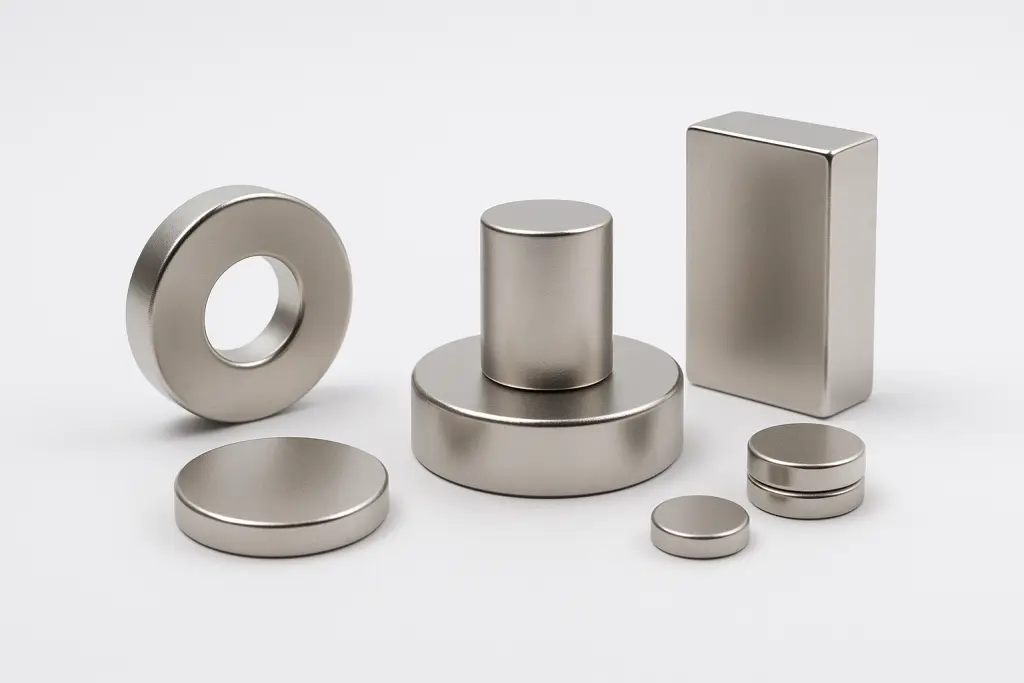
Introduction
Imagine holding a tiny magnet no larger than a coin that can effortlessly lift a 10-kilogram steel block, while right next to it sits a much larger, darker magnet struggling to hold a fraction of that weight. This stark contrast perfectly illustrates the fundamental difference between a small neodymium magnet and a large ceramic magnet. In the world of permanent magnets, these two materials represent the most common and practical choices for engineers, designers, and hobbyists alike.
Neodymium magnets, scientifically known as NdFeB (Neodymium Iron Boron), are the most powerful permanent magnets commercially available today. They belong to the rare-earth magnet family and pack an astonishing amount of magnetic energy into remarkably small volumes. On the other hand, ceramic magnets, also referred to as ferrite magnets, are composed of iron oxide mixed with strontium or barium carbonate. While they may lack the raw power of their rare-earth counterparts, they have been the reliable, cost-effective workhorses of the magnetic industry for decades.
Understanding the nuances of Neodymium vs Ceramic magnets is more critical than ever in 2026. As industries push toward miniaturization in electronics, higher efficiency in electric vehicles (EVs), and more sustainable manufacturing practices, the choice of magnetic material can make or break a product’s performance and budget. Fluctuating rare-earth market prices and advancements in high-temperature magnetic applications further complicate this decision. This comprehensive guide will dissect the differences in strength, cost, durability, and practical applications, providing you with the definitive knowledge to choose the right magnet for your specific needs in 2026.
What Are Neodymium Magnets?
Neodymium magnets (NdFeB) are the strongest type of rare-earth magnet available on the market. Their remarkable magnetic properties stem from their unique chemical composition and crystalline structure.
Composition and Manufacturing
The core material of a neodymium magnet is an alloy primarily composed of Neodymium (Nd), Iron (Fe), and Boron (B), forming the Nd₂Fe₁₄B tetragonal crystalline structure. This specific arrangement allows the atomic magnetic moments to align strongly, generating an intense magnetic field. The manufacturing process is highly specialized. The raw materials are melted, cast, and crushed into a fine powder. This powder is then pressed into molds under a strong magnetic field to align the particles (anisotropic alignment) before being sintered at high temperatures in a vacuum furnace. Because the resulting material is highly susceptible to corrosion, neodymium magnets are almost always coated or plated with materials like nickel, zinc, or epoxy.
Grades (N35–N52)
Neodymium magnets are categorized by grades, which indicate their maximum energy product (BHmax) measured in MegaGauss Oersteds (MGOe). The “N” stands for Neodymium, and the number following it represents the magnetic strength.
- N35 to N42:These are considered standard grades, offering an excellent balance of high strength and affordability for general applications.
- N45 to N50:High-performance grades used when space is at a premium and maximum pull force is required.
- N52:Currently the highest widely available commercial grade, delivering the absolute maximum magnetic strength possible for its size.
Additionally, letters following the number (like M, H, SH, UH, EH, AH) indicate the magnet’s temperature rating and intrinsic coercivity, which determines its ability to withstand heat without demagnetizing.
What Are Ceramic Magnets?
Ceramic magnets, commonly known as ferrite magnets, are the most widely used permanent magnets globally due to their low cost and excellent resistance to corrosion and demagnetization.
Composition and Manufacturing
Unlike rare-earth magnets, ceramic magnets are made from abundant and inexpensive materials. They are primarily composed of iron oxide (Fe₂O₃) combined with either strontium carbonate (SrCO₃) or barium carbonate (BaCO₃). The manufacturing process is similar to that of traditional ceramics. The raw materials are mixed, calcined, and milled into a fine powder. This powder can be pressed dry or wet into a die (in the presence of a magnetic field for anisotropic magnets, or without for isotropic magnets) and then sintered at extremely high temperatures. The resulting material is a dark gray, charcoal-like substance that is hard, brittle, and electrically non-conductive.
Common Grades
Ceramic magnets are also graded, though their naming convention differs from neodymium. In the US, they are typically graded from C1 to C8 (or sometimes up to C11).
- Grade 1 (C1):An isotropic magnet, meaning it can be magnetized in any direction, but it has the lowest magnetic strength. It is often used for simple applications like refrigerator magnets.
- Grade 5 (C5):The most common anisotropic grade, offering significantly higher magnetic strength than Grade 1. It is widely used in motors and speakers.
- Grade 8 (C8):The strongest commercial grade of ceramic magnet, providing the highest magnetic energy and resistance to demagnetization among ferrites.
Head-to-Head Comparison
To truly understand neodymium vs ferrite magnets, we must examine their technical specifications side-by-side. The following table and detailed breakdown highlight the critical differences that dictate their performance in real-world applications.
Technical Comparison Table
Feature / Specification | Neodymium Magnets (NdFeB) | Ceramic Magnets (Ferrite) |
Maximum Energy Product (BHmax) | 30 – 52 MGOe | 1.05 – 3.8 MGOe |
Remanence (Br) | 10,000 – 14,800 Gauss | 2,000 – 4,000 Gauss |
Coercivity (Hc) | 10,000 – 12,000 Oersteds | 2,400 – 3,200 Oersteds |
Maximum Operating Temp | 80°C (Standard) up to 220°C (High-Temp) | 250°C |
Curie Temperature | 310°C – 350°C | 450°C |
Corrosion Resistance | Poor (Requires coating/plating) | Excellent (No coating needed) |
Cost | High (Subject to rare-earth market) | Very Low (Abundant materials) |
Physical Characteristics | Metallic, shiny (due to plating), brittle | Dark gray, ceramic-like, very brittle |
Magnetic Strength & Pull Force
When comparing neodymium vs ceramic magnets strength, neodymium is the undisputed champion. A neodymium magnet can be 5 to 10 times stronger than a ceramic magnet of the exact same size. This massive difference in pull force allows engineers to drastically reduce the size and weight of their designs without sacrificing magnetic performance.
Cost per Unit and Cost per Magnetic Performance
Ceramic magnets are the most cost-effective permanent magnets available. Their raw materials are cheap and abundant. However, when evaluating the cost per unit of magnetic performance (how much pull force you get per dollar), neodymium often provides better value. If your application requires a strong magnetic field, achieving it with ceramic magnets would require an impractically large and heavy magnet, making neodymium the smarter financial and engineering choice despite its higher initial unit cost.
Weight and Size
Because neodymium magnets possess such a high energy density, they offer a significantly higher strength-to-weight ratio. This is a critical factor in industries like aerospace, automotive (especially EVs), and consumer electronics, where minimizing weight and footprint is essential. Ceramic magnets require much more volume and mass to generate a comparable magnetic field.
Temperature Resistance & Stability
This is an area where ceramic magnets traditionally hold an advantage. Standard neodymium magnets (N-series) begin to lose their magnetism permanently if heated above 80°C (176°F). While specialized high-temperature neodymium grades (like AH or EH) can operate up to 220°C, they are considerably more expensive. Ceramic magnets, however, can comfortably operate in temperatures up to 250°C (482°F) without significant long-term degradation, making them ideal for high-heat environments.
Corrosion & Durability
Neodymium magnets are highly susceptible to oxidation. Because they contain a large amount of iron, they will rust rapidly if exposed to moisture, which destroys their magnetic properties. Therefore, they require protective coatings—most commonly a triple layer of Nickel-Copper-Nickel (Ni-Cu-Ni). Ceramic magnets, being composed of iron oxide, are inherently highly resistant to corrosion. They can be used outdoors or in wet environments without any protective plating.
Brittleness & Mechanical Strength
Both types of magnets are brittle and prone to chipping or breaking upon impact. However, because neodymium magnets are so powerful, they pose a higher risk of breaking themselves if allowed to snap together forcefully. Ceramic magnets are also very brittle (like a ceramic coffee mug) and can easily chip if dropped or subjected to mechanical stress.
Energy Product (BHmax)
The Maximum Energy Product (BHmax) is the definitive measure of a magnet’s overall strength. Neodymium magnets boast BHmax values ranging from 30 to 52 MGOe, representing the highest magnetic energy density available. Ceramic magnets peak around 3.8 MGOe. This vast disparity explains why a tiny neodymium disc can outperform a bulky ceramic block.
Remanence (Br) and Coercivity (Hc)
Remanence (Br) measures the strength of the magnetic field retained by the magnet. Neodymium’s high Br (up to 14,800 Gauss) means it projects a much stronger field. Coercivity (Hc) measures the resistance to demagnetization. Neodymium has exceptionally high coercivity, meaning it takes a massive external force to demagnetize it. Ceramic magnets have lower coercivity and can actually be demagnetized if placed in direct contact with a strong neodymium magnet.
Strength Comparison in Real Numbers
To put the neodymium vs ceramic magnets strength debate into perspective, let’s look at real-world pull force numbers. The pull force is the amount of weight required to pull a magnet straight off a thick, flat steel plate.
Pull Force Examples
Magnet Size (Diameter x Thickness) | Neodymium (Grade N52) Pull Force | Ceramic (Grade C8) Pull Force | Strength Multiplier |
Small: 1/2″ x 1/8″ (12.7mm x 3.175mm) | ~6.4 lbs (2.9 kg) | ~0.5 lbs (0.22 kg) | ~12.8x Stronger |
Medium: 1″ x 1/4″ (25.4mm x 6.35mm) | ~25 lbs (11.3 kg) | ~2.5 lbs (1.13 kg) | ~10x Stronger |
Large: 2″ x 1/2″ (50.8mm x 12.7mm) | ~100+ lbs (45+ kg) | ~10 lbs (4.5 kg) | ~10x Stronger |
Side-by-Side Testing Scenarios
Imagine you need a magnet to hold a heavy tool on a metal rack. A 1-inch diameter neodymium magnet could easily hold a 20-pound wrench. To achieve the same holding power with a ceramic magnet, you would need a block roughly the size of a brick. In scenarios where space and weight are restricted—such as inside a high-end headphone speaker or an electric motor—neodymium is the only viable option.
Cost Analysis (2026 Updated)
The financial aspect of neodymium vs ferrite magnets is often the deciding factor for large-scale manufacturing and procurement.
Raw Material Prices
In 2026, the rare-earth market continues to experience volatility. The price of Neodymium-Praseodymium (NdPr) oxide, the primary ingredient in NdFeB magnets, hovers around $110 to $125 USD per kilogram [1] [2]. This high cost is driven by the complex extraction and refinement processes, as well as geopolitical factors surrounding rare-earth mining. Conversely, the iron oxide and strontium carbonate used in ceramic magnets cost mere cents per kilogram, making them incredibly cheap to produce in bulk.
Manufacturing Cost
The manufacturing process for neodymium is also more energy-intensive and requires specialized equipment, including vacuum furnaces and protective plating facilities. Ceramic magnets are produced using standard ceramic pressing and sintering techniques, further driving down their unit cost.
Long-Term Cost of Ownership
While a ceramic magnet might cost $0.34 and a similarly sized neodymium magnet costs $0.99, the true cost lies in the performance [3]. As demonstrated in the pull force examples, you might get 6.5 lbs of force per dollar with neodymium, compared to only 3.4 lbs of force per dollar with ceramic. If your design requires a specific magnetic field strength, using neodymium allows you to use a much smaller magnet, saving on housing materials, shipping weight, and overall product size.
When Neodymium is Worth the Premium
Neodymium is worth the premium when:
- Space and weight are severely restricted (e.g., aerospace, wearables).
- Maximum magnetic strength is non-negotiable (e.g., magnetic separators, heavy-lifting equipment).
- The overall cost savings from a smaller, lighter product design outweigh the higher cost of the magnet itself.
Advantages and Disadvantages
Neodymium Magnets
Pros:
- Unmatched magnetic strength (highest BHmax available).
- Incredible strength-to-weight and strength-to-size ratios.
- High resistance to demagnetization (high coercivity).
- Enables miniaturization of technology and high-efficiency motors.
Cons:
- High cost subject to volatile rare-earth markets.
- Poor corrosion resistance; requires protective plating.
- Standard grades lose magnetism above 80°C (176°F).
- Extremely brittle; can shatter if they collide forcefully.
Ceramic Magnets
Pros:
- Very low cost; the most affordable permanent magnet.
- Excellent corrosion resistance; no plating required.
- High operating temperature up to 250°C (482°F).
- Stable and abundant raw material supply.
Cons:
- Low magnetic strength (low BHmax).
- Requires a large volume to generate a strong magnetic field.
- Brittle and prone to chipping.
- Can be demagnetized by stronger rare-earth magnets.
Best Applications for Each
Choosing the right magnet often comes down to the specific requirements of the application.
Neodymium Applications
Because of their extreme power and compact size, neodymium magnets are essential in high-tech and high-performance industries:
- Electric Vehicles (EVs) and Wind Turbines:High-efficiency motors and generators rely on NdFeB magnets to maximize power output while minimizing weight.
- Consumer Electronics:Hard disk drives (HDDs), high-fidelity headphones, smartphone speakers, and vibration motors.
- Medical Devices:MRI machines and advanced magnetic therapy equipment.
- Industrial and Robotics:High-torque servo motors, magnetic separators, and precision lifting equipment.
Ceramic Applications
Ceramic magnets excel in applications where cost is the primary concern, space is abundant, and extreme strength is not required:
- Everyday Items:Refrigerator magnets, magnetic whiteboards, and simple latches.
- Audio Equipment:Large loudspeakers and subwoofers where the weight of the magnet is not an issue.
- Automotive and Appliances:Low-cost DC motors in windshield wipers, power windows, and household appliances (blenders, microwaves).
- Industrial:Magnetic sweepers, basic holding assemblies, and educational tools.
How to Choose Between Neodymium and Ceramic Magnets
To make the right choice for your 2026 project, use this practical decision guide:
- Determine Your Space and Weight Constraints:
- Is the design space severely limited?Choose Neodymium.
- Is weight reduction critical?Choose Neodymium.
- Do you have plenty of space and weight isn’t an issue?Consider Ceramic.
- Assess the Required Magnetic Strength:
- Do you need maximum pull force or a very strong magnetic field?Choose Neodymium.
- Is a moderate or weak holding force sufficient?Choose Ceramic.
- Evaluate the Operating Environment:
- Will the magnet be exposed to high temperatures (above 80°C/176°F)?Choose Ceramic or invest in high-temp Neodymium grades.
- Will the magnet be exposed to moisture or corrosive elements?Choose Ceramic or ensure the Neodymium magnet has a robust, waterproof coating (like epoxy or plastic).
- Analyze Your Budget:
- Is minimizing the unit cost the absolute highest priority?Choose Ceramic.
- Are you optimizing for cost-per-performance and overall product efficiency?Evaluate Neodymium.
Future Trends
As we move through 2026 and beyond, the magnet industry is evolving rapidly to address supply chain vulnerabilities and environmental concerns.
Price Outlook for Rare Earths: The demand for NdFeB magnets is skyrocketing due to the global push for EVs and renewable energy. While prices for Neodymium and Praseodymium (NdPr) have seen fluctuations, the long-term outlook suggests prices will remain elevated as demand outpaces new mining projects.
Recycling and “Urban Mining”: To combat high costs and ethical concerns surrounding rare-earth mining, recycling is becoming a massive industry. Extracting neodymium from end-of-life hard drives, EV motors, and wind turbines is proving to be a viable, sustainable source of rare earths.
New Alternatives: Researchers are heavily investing in developing heavy-rare-earth-free (HRE-free) neodymium magnets and entirely new magnetic materials (like Iron Nitride) that bridge the performance gap between cheap ceramics and expensive rare earths. However, sintered NdFeB remains the gold standard for high performance in 2026.
Conclusion
The debate of Neodymium vs Ceramic magnets is not about which magnet is universally “better,” but rather which is the right tool for the job.
Neodymium magnets are the undisputed kings of strength, enabling the miniaturization of technology and driving the green energy revolution. However, their high cost, susceptibility to corrosion, and temperature limitations mean they must be used strategically. Ceramic magnets, while weaker and bulkier, offer unbeatable cost-effectiveness, excellent heat resistance, and rugged durability against the elements.
By carefully evaluating your project’s constraints regarding size, strength, temperature, and budget, you can make an informed decision that optimizes both performance and profitability in 2026.
Lorem ipsum dolor sit amet, consectetur adipiscing elit. Ut elit tellus, luctus nec ullamcorper mattis, pulvinar dapibus leo.