


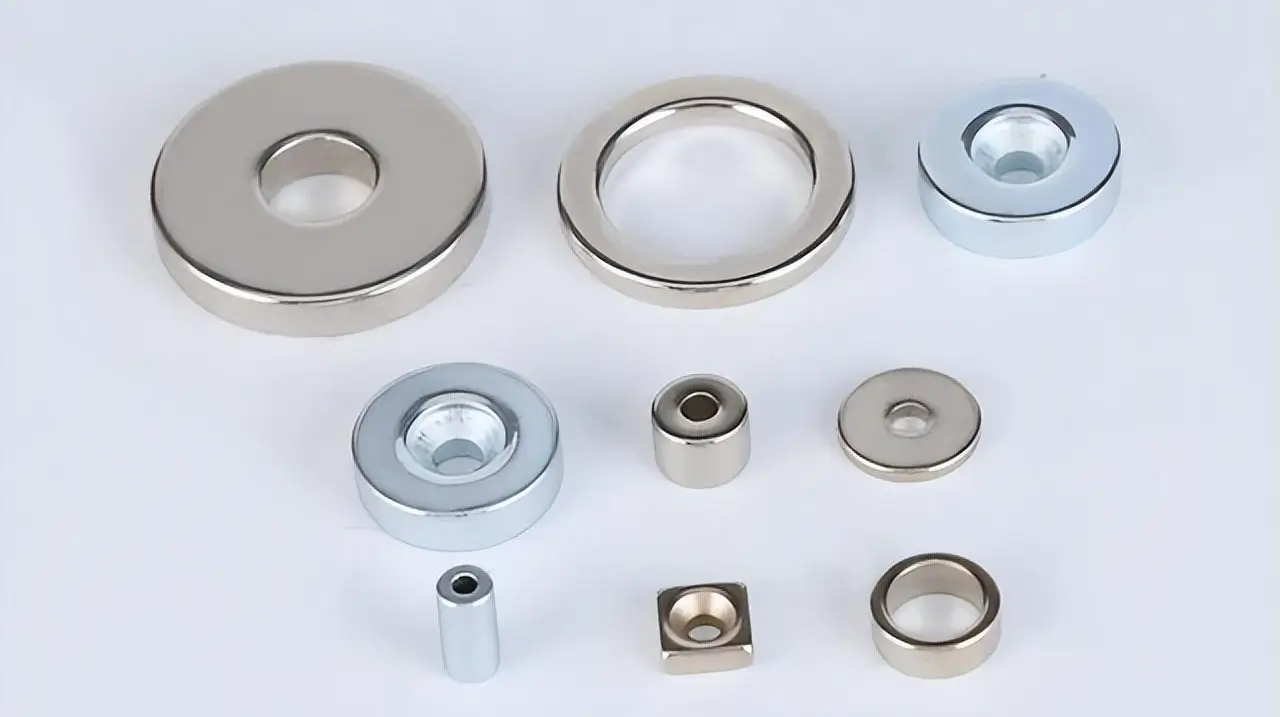
Engineers need the right magnetic material for motors and electronics. They choose sintered NdFeB magnets because these magnets have incredible strength and many uses. You cannot just ask for the strongest magnet. Builders must understand the grades of sintered NdFeB magnets to balance power, heat resistance, and price.
This guide explains everything about sintered neodymium magnet grades. We decode labels like N35 and N52. We explore the high-temperature letters like M, H, SH, UH, EH, and AH. You will find a clear chart to help you pick the best magnet for your project.
Introduction to Sintered NdFeB Magnets
Factories make sintered NdFeB magnets from neodymium, iron, and boron. Scientists created these rare-earth magnets in the 1980s, and they offer the highest magnetic energy product (BHmax) in the world. This huge energy allows engineers to build tiny parts with huge magnetic force.
Why do NdFeB magnet grades matter? Heat destroys the magnetic field in neodymium magnets easily, and water causes rust if the magnet lacks a coating. Makers change the chemical mix by adding metals like dysprosium to create different grades for different jobs. You must learn these grades to stop your magnet from failing in the real world.
How NdFeB Magnet Grades Are Designated
The names for sintered neodymium magnet grades look confusing at first. The labels follow a very strict and logical rule. A typical name like N42SH breaks down into three simple parts:
- The Prefix (“N”): The letter “N” means Neodymium. It shows the main rare-earth metal in the magnet.
- The Number (e.g., “42”): This number shows the Maximum Energy Product (BHmax). It measures the total strength of the magnet in Mega-Gauss Oersteds (MGOe). A higher number creates a stronger magnetic pull. Normal grades go from N30 to N52 today.
- The Suffix (e.g., “SH”): The letters at the end show the heat limit and the resistance to losing magnetism (Hcj). A magnet has a standard heat limit if the name has no letters at the end.
Engineers read the grade to know the strength and the heat limit instantly.
Detailed Breakdown of Main Grade Series
We must look at key magnetic traits to understand NdFeB magnet grades. These traits define how the magnet works:
- Remanence (Br): This measures the magnetic field left inside the magnet after a machine magnetizes it. A higher Br creates a stronger pull.
- Coercive Force (Hcb): This shows the outside force needed to erase the magnet.
- Intrinsic Coercivity (Hcj): This measures the magnet’s natural power to fight off demagnetization, especially when it gets hot.
- Maximum Energy Product (BHmax): This shows the total magnetic energy stored inside the metal.
Standard Grades (N35 – N52)
These grades are very common and save money. They have a maximum heat limit of 80°C (176°F).
- N35 to N42: Factories use these workhorse magnets for a great balance of power and price. Builders love N42 because it gives 20% more strength than N35 for a fair cost.
- N45 to N52: Engineers pick these premium grades when they need huge power in a tiny space. N52 is the strongest neodymium magnet you can buy easily.
High-Temperature Grades (M, H, SH, UH, EH, AH)
Standard magnets lose their power forever when the heat passes 80°C. Factories add heavy rare earth metals to increase the Intrinsic Coercivity (Hcj) and fight this heat loss.
- M (Medium): These magnets handle heat up to 100°C. They work great in slightly warm places.
- H (High): These magnets survive up to 120°C. Builders put them in normal motors and factory machines.
- SH (Super High): These magnets work safely up to 150°C. Car sensors and strong electric motors use them often.
- UH (Ultra High): These magnets endure heat up to 180°C. Heavy machines and power generators need them.
- EH (Extreme High): These magnets resist heat up to 200°C. Fast spinning rotors and airplane parts require them.
- AH (Advanced High): These magnets withstand heat up to 230°C. They are the ultimate heat fighters for neodymium before you must switch to Samarium Cobalt (SmCo) magnets.
Temperature Ratings and Maximum Operating Temperatures
Heat affects neodymium magnets very badly. The magnetic power drops as the temperature goes up. The magnet loses about 0.12% of its strength for every single degree Celsius it heats up.
The magnet suffers permanent damage if it crosses its Maximum Operating Temperature. It will never get its full strength back even when it cools down to room temperature. You must pick the correct letter suffix to avoid this permanent loss.
The shape of the magnet also changes how it handles heat. A very thin magnet loses its power at a lower temperature than a thick magnet of the exact same grade.
NdFeB Magnet Grade Comparison Chart
This NdFeB magnet grade chart compares common grades, their power, and their heat limits.
Grade | Remanence (Br) mT | Intrinsic Coercivity (Hcj) kA/m | Max Energy Product (BHmax) kJ/m³ | Max Operating Temp (°C) | Typical Application |
N35 | 1170 – 1220 | ≥ 955 | 263 – 287 | 80°C | Packaging, craft, basic holding |
N42 | 1280 – 1320 | ≥ 955 | 318 – 342 | 80°C | Audio equipment, standard consumer goods |
N52 | 1430 – 1480 | ≥ 876 | 398 – 422 | 80°C | Miniaturized electronics, high-end sensors |
35M | 1170 – 1220 | ≥ 1114 | 263 – 287 | 100°C | Small motors, magnetic couplings |
42H | 1280 – 1320 | ≥ 1353 | 318 – 342 | 120°C | Industrial automation, servo motors |
45SH | 1320 – 1380 | ≥ 1592 | 342 – 366 | 150°C | Electric vehicle (EV) motors, wind turbines |
35UH | 1180 – 1220 | ≥ 1990 | 263 – 287 | 180°C | High-temperature industrial generators |
33EH | 1130 – 1170 | ≥ 2388 | 247 – 271 | 200°C | Aerospace components, heavy machinery |
28AH | 1040 – 1090 | ≥ 2624 | 207 – 231 | 230°C | Extreme environments, downhole drilling |
N52 vs. Lower Grades: Performance, Cost, and Stability
Engineers often fight over the N52 vs N35 magnet choice. Why not use N52 for everything if it is the strongest? The answer involves power, money, and stability.
Performance: N52 has a huge BHmax around 50-53 MGOe, and it pulls much harder than N35 (33-36 MGOe). N52 wins easily if your project needs the biggest holding force in the smallest space.
Cost: Factories spend more money on raw materials to make N52 magnets. An N52 magnet often costs twice as much as an N42 magnet of the same size. You can save money if you just buy a slightly larger N42 magnet instead of a small N52 magnet.
Stability: Magnets lose some resistance to heat (Hcj) when factories push the total energy (BHmax) to the absolute limit. Normal N52 magnets lose their power more easily from heat and outside magnetic fields than lower grades. Factories also find it very hard and expensive to make high-heat versions of the strongest grades like N52SH.
Applications for Different NdFeB Grades
Companies use sintered neodymium magnet grades in almost every modern business:
- Consumer Electronics (N35 – N42, N52):Cell phones, headphones, and hard drives need tiny, powerful magnetic fields. Phone makers put N52 in phone speakers because they have almost no empty space inside the phone.
- Electric Motors and Generators (N42H, N45SH, N38UH):Electric motors create a lot of heat while they run. Electric car motors and wind turbines rely on SH and UH grades to keep working under constant heat stress.
- Medical Devices (N45UH, N50M):MRI machines and exact surgical tools require very stable and safe magnetic fields.
- Industrial Holding and Separation (N35 – N42):Food factories and mines use normal grades for their magnetic separators. They use large magnets to get enough pull without paying for expensive N52 metal.
Factors to Consider When Choosing the Right Grade
You must balance many details to pick the best grade. Think about these rules during your design step:
- Operating Temperature:This is the most important detail. You must find the highest heat the magnet will face and pick a grade rated 10°C to 20°C higher to stay safe.
- Required Magnetic Strength:You need to calculate the exact holding force for your project. You can use computer tests to see if a cheaper grade works by changing the magnet’s size.
- Corrosion Resistance:Sintered NdFeB rusts very fast in the air. You must pick a good coating like Nickel, Zinc, or Epoxy to protect any grade you choose.
- External Demagnetizing Fields:You need a grade with high Intrinsic Coercivity (Hcj) if other magnets push against your magnet. You need this high Hcj even if the room stays cool.
Common Misconceptions and Pro Tips
Misconception 1: “Higher grade always means a better magnet.” Pro Tip: The best magnet is the one that fits your exact job. An N52 magnet will fail completely in a hot engine, but an N35SH will work perfectly.
Misconception 2: “The temperature rating is the temperature the magnet can operate at indefinitely without any loss.” Pro Tip: The heat ratings like 150°C for SH are just the absolute limits. The magnet still loses some power temporarily as it gets hot. You must always plan for this temporary power drop.
Misconception 3: “All N42 magnets are exactly the same.” Pro Tip: Factory quality changes from place to place. You should ask your seller for a B-H curve chart for your specific heat level to check the quality.
Conclusion
Builders must understand the grades of sintered NdFeB magnets to make good products. You can find a special neodymium magnet for almost any problem. You can choose the cheap N35, the super strong N52, or the tough heat fighters from M to AH. You will save money and stop failures if you study your needs for power, heat, and price carefully.