


Executive Summary
How to Select High‑Quality Hard Ferrite Magnets for Industrial and OEM Applications | 2026 Guide addresses critical engineering decisions across DC motors, industrial motors, loudspeakers, sensors, magnetic separators, magnetic holders, automotive components, and consumer products. With rising demand for thermally stable, corrosion-resistant, and cost-optimized magnetic solutions, precision selection of Hard Ferrite Magnets, Ceramic Permanent Magnets, and Industrial Magnet Components has become a cornerstone of robust product design and scalable manufacturing.
Technical Challenge
Designing for reliability in high-duty-cycle environments demands magnets that maintain structural integrity and magnetic output under thermal stress, mechanical load, and variable field exposure. In industrial motors and automotive components, for example, fluctuations in ambient temperature and electromagnetic interference challenge magnet stability. Similarly, magnetic separators and loudspeakers require consistent remanence (Br) and coercivity (Hc) to sustain performance across extended service life—without degradation or demagnetization. The absence of precise material-grade alignment can lead to suboptimal efficiency, premature field decay, or unnecessary over-engineering.
Nibboh Solution
Nibboh’s engineered Hard Ferrite Magnets meet these challenges with verified technical specifications: Remanence (Br) of 2,000–4,000 Gauss, coercivity delivering high resistance to demagnetization, and a Maximum Operating Temperature up to 250°C. Their excellent corrosion resistance eliminates the need for protective coatings in most applications, while their very high electrical resistivity ensures minimal eddy-current losses in dynamic systems. Density (~4.8–5.0 g/cm³) and up to ~4.0 MGOe (BH)max support compact, high-efficiency designs. Nibboh provides Dual Support: US Engineering + China Manufacturing, enabling rapid prototyping, grade optimization, and customizable tolerances on request—ensuring seamless integration into complex assemblies across all specified application scenarios.
Product Spotlight
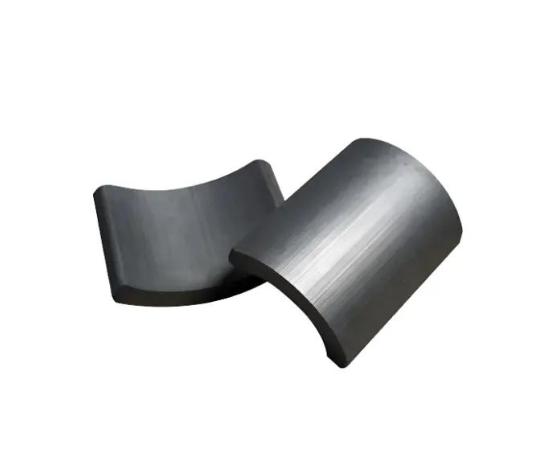
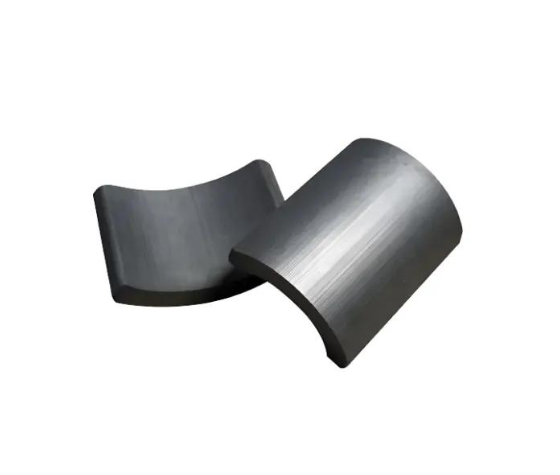
Nibboh’s Hard Ferrite Magnets (Ceramic Permanent Magnets) exemplify this balance of performance and manufacturability. Available in blocks, rings, discs, and custom geometries—including multi-pole and axial magnetization variants—they are purpose-built for DC motors, sensors, loudspeakers, and magnetic holders. Their ceramic composition (Fe₂O₃ + SrCO₃ or BaCO₃) delivers intrinsic thermal and chemical resilience—making them ideal for demanding industrial magnet components where long-term consistency outweighs peak field strength.
Industry Trends
Increasing adoption of hard ferrite magnets is evident in next-generation robotics, eVTOL actuation systems, and factory automation—where reliability, safety, and supply chain resilience are prioritized alongside performance. As system-level integration grows more complex, the role of standardized yet customizable Ceramic Permanent Magnets becomes increasingly strategic—not as commodity parts, but as foundational Industrial Magnet Components enabling modularity, scalability, and lifecycle predictability.
Frequently Asked Questions
Q: What makes hard ferrite magnets different from rare‑earth magnets?
A: Hard ferrite magnets are made from ceramic ferrite materials (iron oxide + barium or strontium carbonate) with excellent corrosion resistance and thermal stability up to ~250°C. While they have lower magnetic strength than rare‑earth magnets like NdFeB, they offer outstanding cost effectiveness and durability for high‑volume applications.
Q: What are common applications for hard ferrite magnets?
A: They are widely used in motors, loudspeakers, magnetic separators, sensor actuators, automotive components, and holding assemblies where reliable magnetic performance and low cost are key priorities.
Q: How do I specify the correct ferrite magnet for my product?
A: Provide the desired geometry, magnetization direction, operating temperature, and mechanical tolerances so a manufacturer can optimize grade and production method.