


High-temperature applications place demanding requirements on permanent magnets. Electric vehicle (EV) traction motors, downhole tools, industrial actuators, and aerospace motion systems regularly expose magnets to elevated temperatures, strong opposing magnetic fields, and repeated thermal cycles.
For these demanding environments, high-temperature NdFeB magnets offer an unmatched combination of high magnetic energy density and strong resistance to irreversible demagnetization. EH grades—such as N33EH, N35EH, N42EH, and N45EH—are standard choices when a design requires high intrinsic coercivity and a maximum operating temperature rating of up to 200°C.
However, selecting the right EH grade involves more than comparing the grade number. Engineers must evaluate remanence, intrinsic coercivity, maximum energy product, the magnetic circuit’s operating point, dimensional tolerances, and coating thermal limits.
This engineering guide compares representative EH-grade specifications, explains grain boundary diffusion (GBD) technology, and outlines the technical details OEM buyers should confirm before ordering custom high-temperature NdFeB magnets.
What Makes EH-Grade NdFeB Magnets Suitable for High-Temperature Applications?
The performance of a sintered NdFeB magnet changes dynamically as temperature rises. Both remanence (Br) and intrinsic coercivity (Hcj) decline with heat. If the magnet’s operating point drops below the knee of its demagnetization curve, permanent, irreversible magnetic loss occurs.
In the sintered NdFeB classification system, EH stands for Extra High coercivity, corresponding to a maximum working-temperature rating of approximately 200°C. Actual thermal limits depend on magnet geometry (permeance coefficient Pc), opposing demagnetizing fields, and assembly heat dissipation.
Compared with standard N- or H-grade neodymium magnets, EH-grade high-temperature NdFeB magnets are engineered for harsh thermal duty in:
- EV traction motors and high-speed rotor assemblies
- Downhole drilling and oilfield logging tools
- Industrial servo motors and linear actuators
- Aerospace motion-control and positioning systems
- High-temperature pumps, compressors, and generators
For applications operating near 200°C, engineers should always review the full second-quadrant demagnetization curve at the actual operating temperature rather than relying on room-temperature catalog labels alone.
EH-Grade NdFeB Magnet Specifications: N33EH, N35EH, N42EH, and N45EH
The table below provides representative room-temperature magnetic property ranges compiled from industry standards. Values are indicative only and do not represent NIBBOH’s certified production limits, which may vary by magnet geometry, composition, and test standard.
| Parameter | N33EH | N35EH | N42EH | N45EH |
| Remanence Br (T) | 1.14 – 1.19 | 1.18 – 1.23 | 1.28 – 1.33 | 1.32 – 1.36 |
| Normal Coercivity Hcb (kA/m) | ≥ 812 – 820 | ≥ 836 – 876 | ≥ 907 – 971 | ≥ 899 – 971 |
| Intrinsic Coercivity Hcj (kA/m) | ≥ 2388 | ≥ 2388 | ≥ 2308 – 2388 | ≥ 2388 |
| Max Energy Product (BH)max (kJ/m³) | 247 – 271 | 263 – 287 | 310 – 342 | 342 – 366 |
| Max Energy Product (MGOe) | 31 – 34 | 33 – 36 | 39 – 43 | 43 – 46 |
| Max Working Temp Rating | ≤ 200°C | ≤ 200°C | Supplier-dependent | ≤ 200°C |
Key Magnetic Property Definitions:
- Br (Remanence): Residual magnetic flux density retained after full saturation magnetization.
- Hcb (Normal Coercivity): Resistance to demagnetization under an externally applied reverse magnetic field.
- Hcj (Intrinsic Coercivity): Resistance to irreversible demagnetization—the most critical indicator for high-temperature NdFeB magnets.
- (BH)max (Maximum Energy Product): Measure of maximum magnetic energy density per unit volume.
Important Note: A 200°C rating does not mean the magnet retains its 20°C flux output at 200°C. In particular, N42EH temperature ratings vary across manufacturers, so always confirm guaranteed minimum Hcj values and temperature limits on your supplier’s official datasheet before placing a production order.
How to Select Between N33EH, N35EH, N42EH, and N45EH
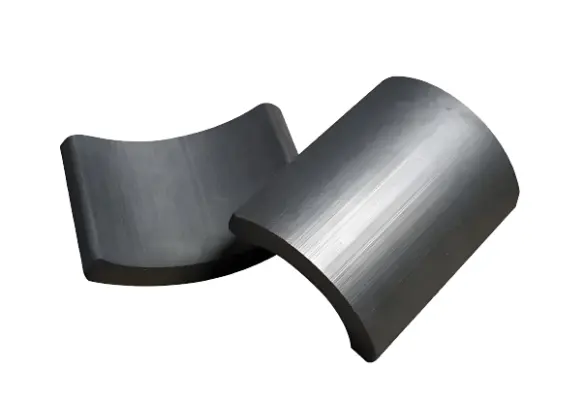
A higher grade number indicates a higher energy product, not necessarily higher thermal stability:
- N33EH (Maximum Demagnetization Margin): Ideal when thermal stability and resistance to strong opposing fields take priority over maximum flux output, and assembly space allows slightly larger magnet volume.
- N35EH (Balanced Performance): Offers a reliable balance between magnetic output and high intrinsic coercivity, making it a practical workhorse for industrial servo motors and actuators.
- N42EH (Compact High Output): Delivers significantly higher energy density than N33EH and N35EH for space-constrained assemblies, provided the supplier’s guaranteed Hcj meets your thermal load.
- N45EH (Peak Energy Density): Designed for space-constrained designs where high flux density is required at elevated temperatures; verify the knee point at your exact peak operating temperature.
Selection Principle: Always select the grade that maintains a safe demagnetization margin at your peak operating temperature—never choose solely based on room-temperature Br or (BH)max.
Grain Boundary Diffusion (GBD): Boosting Coercivity Efficiently
Heavy rare earth elements—specifically Dysprosium (Dy) and Terbium (Tb)—are essential for raising the intrinsic coercivity of sintered NdFeB magnets. Conventional bulk alloying distributes Dy or Tb uniformly throughout the magnet composition, which increases material cost and noticeably reduces remanence (Br).
Grain Boundary Diffusion (GBD) solves this trade-off through targeted surface engineering:
- A thin layer of Dy- or Tb-rich diffusion source is coated onto the surface of a sintered magnet.
- During controlled heat treatment, the heavy rare earth atoms diffuse preferentially along the grain boundaries rather than entering the grain interiors.
- This forms high-anisotropy regions around the main Nd₂Fe₁₄B grains, suppressing the nucleation of reverse magnetic domains.
Key Advantages of GBD for High-Temperature NdFeB Magnets:
- More Efficient Heavy Rare Earth Utilization: Achieves high intrinsic coercivity while significantly reducing heavy rare earth consumption compared to conventional bulk alloying.
- Better Remanence Retention: Preserves higher Br and (BH)max by limiting heavy rare earth concentration inside the main magnetic grains.
- Application-Specific Optimization: Diffusion sources and heat-treatment parameters can be tailored based on magnet thickness, geometry, and thermal requirements (most effective for thinner magnet cross-sections).
When sourcing GBD magnets, ask your manufacturer whether GBD is suitable for your target geometry, what magnetic properties are guaranteed after treatment, and whether batch test data can be provided.
Dimensional Tolerance and Manufacturing Requirements for Custom EH Magnets
Even the right magnetic grade will underperform if mechanical tolerances or surface coatings fail under thermal cycling. Define these three specifications clearly in your OEM drawing:
1. Dimensional Tolerances
Achievable dimensional tolerances depend on magnet geometry, size, machining method, coating thickness, and production volume. Clearly specify critical-to-function tolerances on your engineering drawing for:
- Length, width, and thickness (or outer diameter, inner diameter, and height for ring magnets)
- Arc angle, inner/outer radius, and chord length for motor segment magnets
- Flatness, parallelism, perpendicularity, and corner chamfers
2. Magnetic Tolerances and Inspection
Beyond the grade name, specify:
- Guaranteed minimum Br, Hcb, Hcj, and (BH)max ranges
- Magnetization direction (axial, diametric, radial, or multipole) and pole orientation relative to mechanical datums
- Open-circuit flux or Helmholtz coil magnetic moment requirements, where applicable
- Demagnetization curve verification at elevated test temperatures
3. Coating and Environmental Protection
Sintered high-temperature NdFeB magnets oxidize rapidly without protective plating. Always match the coating’s thermal limit to your operating environment:
- Ni-Cu-Ni (Nickel-Copper-Nickel): Widely used for dry industrial and motor environments up to 200°C, offering strong wear resistance and clean appearance.
- Epoxy Coating: Offers superior salt-spray and chemical corrosion resistance, though standard epoxy formulations typically have lower temperature limits than Ni-Cu-Ni (high-temperature epoxy must be specified for 200°C duty).
- Passivation / Phosphate: Used as temporary protection when magnets will be fully potted, sealed inside a rotor core, or bonded with high-temperature structural adhesives.
Application Considerations for 200°C Environments
- EV Traction Motors: High-speed rotors face both sustained heat and short-duration thermal peaks approaching 200°C alongside strong stator demagnetizing fields. Segmented EH-grade magnets are widely used here to reduce eddy-current heating.
- Downhole Oil & Gas Tools: Require resistance to high temperatures, mechanical shock, vibration, pressure, and corrosive downhole fluids—making hermetic encapsulation and verified Hcj margins mandatory.
- Aerospace Actuators: Demand tight dimensional control, full lot traceability, and repeatable flux output across wide thermal cycling.
Note: If continuous operating temperatures exceed the verified limit of EH-grade NdFeB, engineers should evaluate alternative materials such as Samarium Cobalt (SmCo) magnets.
What to Include in an EH-Grade NdFeB Magnet RFQ
To receive an accurate engineering review and fast quotation, include these 8 items in your RFQ package:
- Target grade (e.g., N35EH, N42EH, N45EH) or required Br / Hcj targets
- Continuous operating temperature and maximum peak temperature
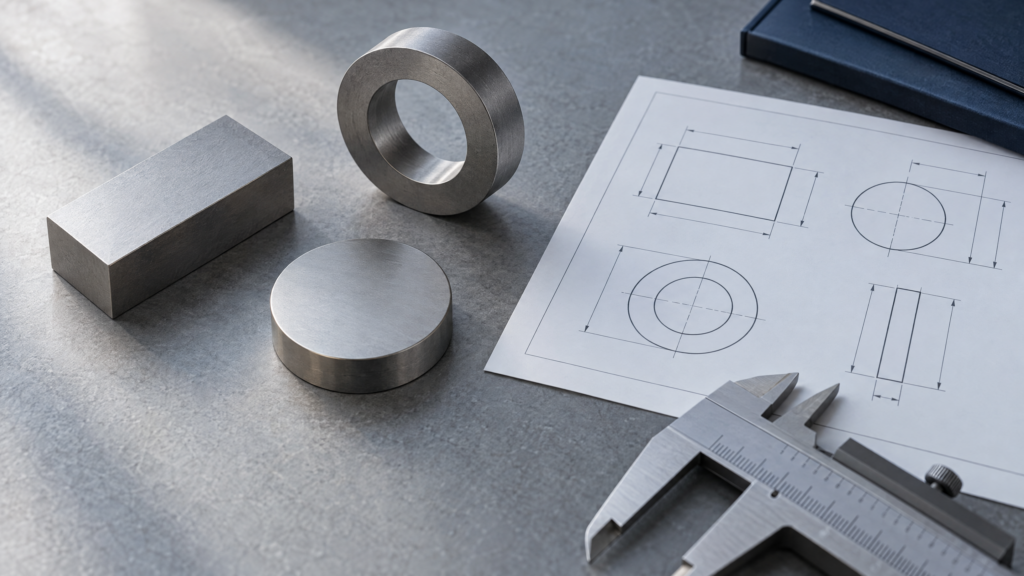
- 2D/3D engineering drawing with critical-to-function dimensions
- Magnetization direction and pole polarity convention
- Coating type and environmental exposure (humidity, oil, chemicals)
- Dimensional and geometric tolerance requirements
- Magnetic inspection criteria (flux limits, high-temp curve testing, sampling plan)
- Prototype quantity, estimated annual volume, and target delivery schedule
Request Custom EH-Grade Magnet Specifications & Quotes from NIBBOH
Selecting the right high-temperature NdFeB magnets requires aligning magnetic grade, GBD processing, coating thermal stability, and mechanical tolerances with your exact circuit load.
NIBBOH manufactures custom sintered NdFeB magnets across N33EH, N35EH, N42EH, and N45EH grades in blocks, discs, rings, and precision motor segments. Share your engineering drawing and operating temperature profile with our technical team to receive a tailored material recommendation and quotation.
Have a project in mind? Contact NIBBOH today to review grade availability, verify guaranteed magnetic limits for your operating temperature, or request a fast OEM quote before placing your production order.
Frequently Asked Questions (FAQs)
What is the maximum working temperature of EH-grade NdFeB magnets?
EH-grade high-temperature NdFeB magnets are rated for a maximum working temperature of approximately 200°C. Actual thermal performance depends on the magnet’s geometry, magnetic circuit permeance coefficient, and opposing demagnetizing fields.
What is the difference between N35EH and N42EH?
N42EH provides a higher maximum energy product and stronger remanence than N35EH, which can help reduce magnet size. However, the right choice depends on your required magnetic output and the supplier’s guaranteed intrinsic coercivity at your actual operating temperature.
Does GBD technology eliminate the need for heavy rare earth elements?
No. Grain boundary diffusion (GBD) still uses Dysprosium (Dy) or Terbium (Tb), but concentrates them along the grain boundaries rather than throughout the entire magnet—significantly reducing heavy rare earth usage while maintaining high coercivity and higher remanence.
Can an N45EH magnet operate continuously at 200°C?
Do not assume continuous 200°C operation from the grade label alone. Verify the supplier’s guaranteed demagnetization curve at 200°C and ensure your magnetic circuit’s operating point stays safely above the knee of the curve.
What tolerances are available for custom EH-grade magnets?
Available tolerances depend on the magnet’s dimensions, geometry, machining process, and surface coating. Critical dimensions should be defined on the engineering drawing and confirmed with NIBBOH‘s engineering team before production.