


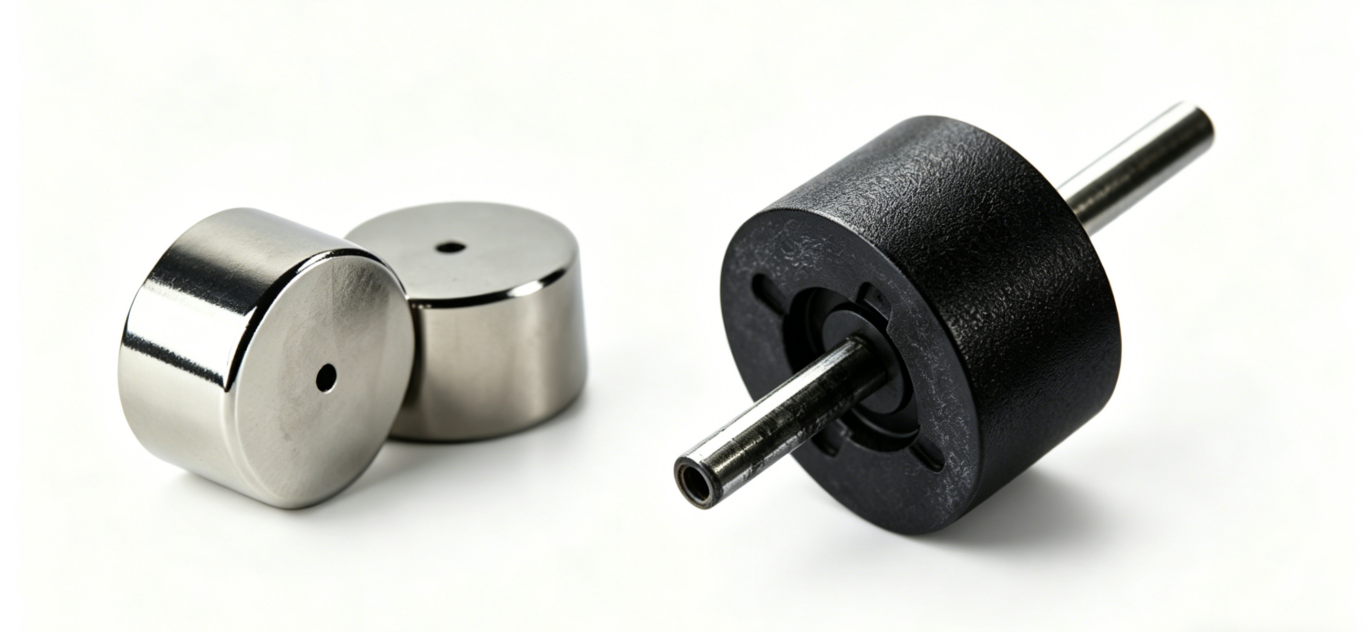
When designing advanced mechatronic systems, automotive sensors, or high-performance electric motors, selecting the right permanent magnet material is a critical engineering decision. The choice between injection molded magnets vs sintered magnets can fundamentally alter a product’s performance, cost structure, and manufacturing scalability. While both types can be formulated from powerful materials like Neodymium Iron Boron (NdFeB) or Ferrite, their distinct manufacturing processes result in entirely different mechanical, magnetic, and geometric properties.
This comprehensive technical guide provides an in-depth comparison of injection molded and sintered magnets. We will explore their manufacturing processes, head-to-head performance metrics, advantages, limitations, and ideal applications to help engineers and procurement teams make data-driven material selection decisions.
What Are Injection Molded Magnets?
Injection molded magnets are engineered composite materials created by blending magnetic powders—such as NdFeB, Samarium Cobalt (SmCo), or Ferrite—with a thermoplastic binder like Nylon (PA6, PA12) or Polyphenylene Sulfide (PPS).
The Manufacturing Process
The production process closely mirrors traditional plastic injection molding. The magnetic compound is heated until the polymer binder melts, then injected under high pressure into a precision-machined mold cavity. Once the material cools and solidifies, the part is ejected. During the injection phase, an external magnetic field can be applied to align the magnetic particles, creating an anisotropic magnet with higher magnetic strength in a specific direction. If no field is applied, the resulting magnet is isotropic and can be magnetized in any direction, albeit with lower overall strength.
Key Characteristics
The defining characteristic of injection molded magnets is their exceptional design flexibility. Because the material flows into a mold, manufacturers can produce complex geometries, thin walls, and intricate features like internal gears or snap-fits without the need for secondary machining. The polymer matrix also provides inherent toughness, making these magnets highly resistant to chipping and cracking compared to their brittle sintered counterparts. Furthermore, the binder offers a degree of natural corrosion resistance, often eliminating the need for protective surface coatings.
What Are Sintered Magnets?
Sintered magnets represent the pinnacle of permanent magnetic strength. They are produced through a sophisticated powder metallurgy process that maximizes the density of the magnetic material.
The Manufacturing Process
To create a sintered magnet, raw materials are melted and cast into alloys, which are then milled into a fine powder. This powder is compacted under immense pressure in a die, typically while exposed to a strong magnetic field to align the crystallographic axes of the particles. The compacted “green” part is then sintered in a vacuum or inert gas furnace at temperatures approaching 1,000°C. Sintering fuses the particles together, achieving a near-theoretical maximum density.
Key Characteristics
Because sintered magnets lack a non-magnetic polymer binder, they boast the highest volumetric loading of magnetic material, resulting in exceptionally high energy products (BHmax) and coercivity. However, this fully dense, polycrystalline microstructure makes sintered magnets extremely brittle and ceramic-like. They cannot be molded into complex shapes; instead, simple blocks, rings, or cylinders are produced and then precision-machined or ground to final dimensions. Additionally, sintered rare-earth magnets, particularly NdFeB, are highly susceptible to oxidation and require robust protective coatings such as Nickel-Copper-Nickel (Ni-Cu-Ni) or epoxy.
Head-to-Head Comparison: Injection Molded vs Sintered Magnets
To facilitate optimal material selection, the following table provides a direct technical comparison between injection molded and sintered NdFeB magnets, the most common high-performance variants.
Technical Parameter | Injection Molded Magnets | Sintered Magnets |
Microstructure | Polymer-bonded composite, isotropic or mildly anisotropic | Fully dense, polycrystalline, highly grain-oriented |
Magnetic Strength (BHmax) | Moderate (typically 5 – 10 MGOe) | Very High (up to 52+ MGOe) |
Coercivity (Resistance to Demagnetization) | Moderate; limited by polymer matrix thermal constraints | High; specific grades formulated for extreme environments |
Operating Temperature | Up to 150°C (binder dependent, e.g., PPS) | Up to 230°C (grade dependent) |
Mechanical Properties | Tough, impact-resistant, flexible | Brittle, low tensile strength, prone to chipping |
Design Flexibility | Excellent; complex shapes, over-molding, tight off-tool tolerances | Limited; simple shapes requiring secondary machining |
Dimensional Tolerance | Very high precision directly from the mold (e.g., ±0.05mm) | Requires grinding/machining to achieve tight tolerances |
Corrosion Resistance | Good; polymer matrix protects magnetic powder | Poor (for NdFeB); requires plating or coating |
Production Volume Suitability | Ideal for high-volume, automated production | Suitable for medium to high volume; higher labor input |
Tooling Cost | High initial mold investment | Lower initial tooling, higher per-part machining cost |
Advantages of Injection Molded Magnets
When evaluating injection molded magnets vs sintered magnets, the bonded variants offer several distinct engineering advantages that solve complex design challenges:
- Unmatched Geometric Complexity: Injection molding allows for the creation of intricate shapes that are impossible to machine from brittle sintered materials. Engineers can integrate mounting holes, gears, and precise multi-pole magnetization patterns directly into the component.
- Consolidation of Parts: Through over-molding or insert molding, a magnetic component can be directly molded onto a shaft, housing, or sensor lead frame. This reduces assembly steps, lowers part counts, and improves overall system reliability.
- Exceptional Dimensional Accuracy: Injection molded parts achieve tight tolerances straight out of the mold, eliminating the need for expensive and time-consuming secondary grinding operations.
- Mechanical Durability: The thermoplastic binder absorbs shock and vibration, preventing the chipping and cracking that frequently plague sintered magnets during assembly and operation.
Advantages of Sintered Magnets
Despite the manufacturing flexibility of molded options, sintered magnets remain indispensable for applications demanding raw power:
- Maximum Magnetic Performance: With energy products exceeding 50 MGOe for NdFeB, sintered magnets generate the strongest magnetic fields possible for their size [1]. This is critical for miniaturizing high-power devices.
- Superior Temperature Stability: Sintered magnets, particularly high-coercivity grades of NdFeB and SmCo, can operate reliably in high-temperature environments (up to 230°C for NdFeB and 350°C for SmCo) without suffering irreversible demagnetization.
- High Coercivity: The fully dense microstructure provides excellent resistance to demagnetizing fields, making them ideal for dynamic applications like electric vehicle traction motors.
Key Limitations and Trade-offs
Choosing between these two technologies requires balancing inherent trade-offs:
- The Performance vs. Shape Trade-off: The primary limitation of injection molded magnets is their reduced magnetic strength. Because the polymer binder dilutes the magnetic powder (typically comprising 30-40% of the volume), the resulting energy product is significantly lower than a sintered magnet of the same size.
- The Machining vs. Tooling Cost Trade-off: Sintered magnets are restricted to simple geometries (blocks, discs, arcs) and require costly diamond grinding to achieve precise dimensions. Conversely, while injection molded magnets require zero post-machining, the initial capital expenditure for the injection mold tooling can be substantial, making them less viable for low-volume production runs.
Common Applications: Where Each Type Excels
The divergent properties of these materials dictate their ideal use cases in the B2B industrial landscape.
Applications for Injection Molded Magnets
Due to their precision, toughness, and ability to hold complex multi-pole magnetization patterns, injection molded magnets are the preferred choice for:
- Automotive Sensors: ABS sensors, throttle position sensors, and steering angle sensors where precise magnetic field profiles are required.
- Small BLDC Motors: Rotor assemblies for cooling fans, drone gimbals, and precision mechatronics.
- Consumer Electronics: Haptic feedback mechanisms, magnetic encoders, and acoustic transducers.
Applications for Sintered Magnets
When raw power, high torque, and extreme environmental resilience are non-negotiable, sintered magnets are deployed:
- Electric Vehicle (EV) Traction Motors: High-power density sintered NdFeB is critical for maximizing range and motor efficiency.
- Industrial Automation: Servo motors, heavy-duty magnetic couplings, and magnetic separators.
- Renewable Energy: Large-scale wind turbine generators relying on massive sintered magnet arrays.
Cost Analysis and Total Cost of Ownership
Procurement teams must look beyond the raw material price per kilogram when comparing injection molded vs sintered magnets. The total cost of ownership (TCO) is heavily influenced by the manufacturing process and production volume.
For sintered magnets, the material cost is high, and the secondary machining processes add significant labor and time expenses. Furthermore, the mandatory protective coatings (like Ni-Cu-Ni) add to the unit price.
For injection molded magnets, the raw material cost per unit volume is lower due to the polymer dilution. The per-part manufacturing cost is also extremely low in high volumes because the process is highly automated and yields net-shape parts with zero scrap from grinding. However, the high upfront cost of the injection mold means this technology is only cost-effective when amortized over large production runs (typically tens of thousands to millions of units).
How to Choose Between Injection Molded and Sintered Magnets
To make the optimal selection for your engineering project, evaluate the following decision matrix:
- What is the required magnetic strength?If you need maximum holding force or torque in a constrained space, specify sintered magnets. If moderate strength is sufficient, injection molded magnets are viable.
- How complex is the part geometry?If the design requires thin walls, internal features, or integration with other components, injection molded magnets are the only practical choice.
- What is the operating environment?For temperatures exceeding 150°C or environments with high demagnetizing fields, sintered magnets (properly coated) are required. For high-vibration environments where chipping is a risk, molded magnets excel.
- What is the production volume?High-volume production justifies the tooling cost of injection molded magnets, whereas low-volume prototyping favors simple sintered blocks.
Conclusion
The debate of injection molded magnets vs sintered magnets is not about which material is universally better, but rather which manufacturing technology aligns with your specific engineering requirements. Sintered magnets are the undisputed champions of raw magnetic power and high-temperature stability, essential for heavy-duty motors and generators. Conversely, injection molded magnets offer unparalleled design freedom, mechanical toughness, and cost-efficiency for high-volume, complex precision components like sensors and small actuators.
By carefully analyzing your application’s magnetic performance needs, geometric constraints, and production volumes, you can select the optimal magnetic material to drive your product’s success.