

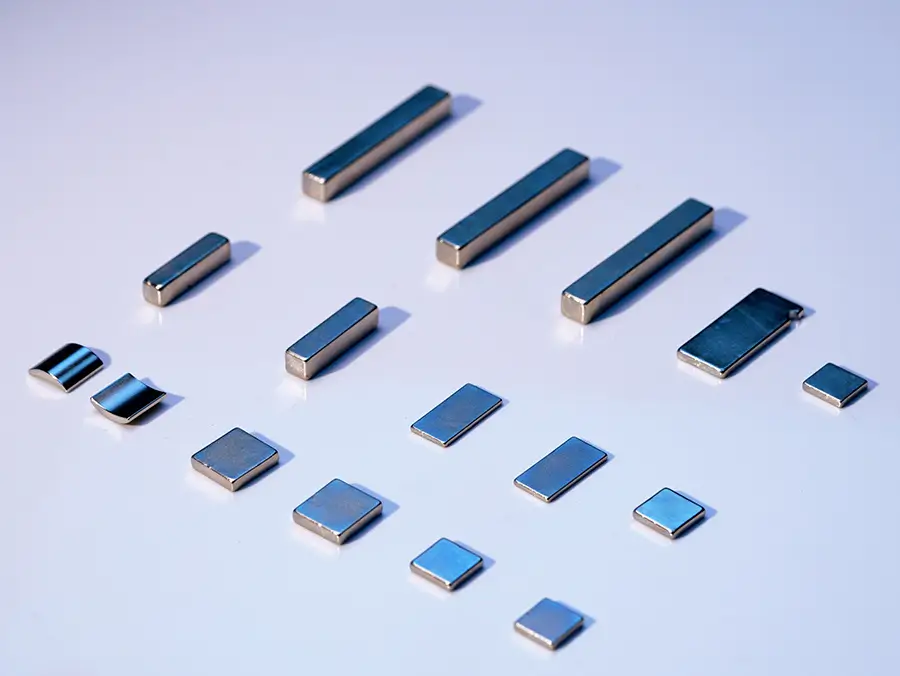
Small magnets hold many papers. Electric car motors use them. Neodymium magnets do amazing things. Their strength comes from tiny changes inside. This guide answers a question: Why do domains of neodymium magnets align with an external magnetic field?
This guide explores magnetic domains. We look at NdFeB magnets. We explain the physics. This makes tiny parts line up. You will understand the external magnetic field effect. It turns metal into a strong magnet.
What Are Magnetic Domains?
First, we must understand what happens inside a magnet. Atoms in ferromagnetic materials act like tiny magnets. Iron and cobalt are examples. Their electrons spin. These atoms do not act alone. They form groups. These groups are magnetic domains.
A magnetic domain is a small area. All atomic magnets point the same way inside it. Think of these domains as tiny neighborhoods. In an unmagnetized metal, these neighborhoods point randomly. They cancel each other out. The material shows no magnetism.
Why Neodymium Magnets Are Special
Many materials are ferromagnetic. Neodymium magnets are special. Their secret is their chemical makeup. It is Nd2Fe14B. This mix has neodymium, iron, and boron. It creates a special crystal structure. This structure is very “anisotropic.”
Magnetic alignment physics in neodymium magnets uses magnetocrystalline anisotropy. This means the crystal has a favorite direction. We call this the “easy axis.” It is the c-axis in the crystal structure.
Feature | Neodymium Magnets (NdFeB) | Standard Ferrite Magnets |
Magnetic Strength | Very Strong (Up to 52 MGOe) | Not as Strong (Up to 4 MGOe) |
Coercivity | Very High (Hard to demagnetize) | Medium |
Material Cost | More Expensive (Rare earth elements) | Very Cheap |
Common Uses | Electric Cars, Wind Turbines, Hard Drives | Fridge Magnets, Speakers |
Neodymium atoms resist changing their magnetic direction. They stay lined up. This makes them super strong magnets. They are stronger than iron or ceramic magnets. This resistance is key to their power.
The Physics Behind Alignment
You place an unmagnetized neodymium magnet into a strong external magnetic field. An energy struggle begins. The material wants its lowest energy state. This is how alignment happens.
1.Magnetic Push and Energy
Each tiny magnetic part inside a domain feels a magnetic torque. This is a twisting force. The external field pushes these domains. The magnetic part’s energy is lowest. It lines up perfectly. This is a basic physics rule.
2.Domain Wall Movement
Magnetization starts. Domains pointing with the external field grow. They use domain wall motion. The edges between domains move. Favored domains take over unfavored ones. This process is reversible in weak fields. It becomes permanent as the field gets stronger.
3.Domain Rotation
The external magnetic field effect grows stronger. Domain wall motion is not enough. Remaining domains point in tough directions. They must turn their magnetic parts. They align with the field. This overcomes the crystal’s “easy axis.” This is magnetocrystalline anisotropy.
4.Reaching Magnetic Saturation
The external field becomes strong enough. All domains have grown or turned. They point the same way. The magnet reaches “saturation.” You cannot make it stronger. Every tiny “atomic soldier” already faces the same way.
Step-by-Step: How Domains Actually Align
Let’s use a simple example. Imagine soldiers in a large field. These soldiers are like atomic moments. Their squads are like domains.
1.The Random Crowd (Unmagnetized): Soldiers stand in small groups. They chat and face different ways. The crowd looks messy. No unified front exists.
2.The General’s Command (Applying the External Field): A general appears at one end. He shouts an order. All soldiers must face him.
3.Expanding the Front (Domain Wall Motion): Squads facing the general start to grow. Soldiers from nearby groups turn. They join the growing squads. Organized squad boundaries move out.
4.The Forced Turn (Domain Rotation): Some squads face the wrong way. The general’s voice gets louder. These soldiers must pivot. They all face the general.
5.Perfect Formation (Saturation): Every soldier stands at attention. They face the general in perfect rows. The field has a strong, unified presence.
Explore different. You see how alignment affects performance.
Real-World Applications and Experiments
Neodymium magnets domains align external magnetic field very well. This makes them vital in modern tech. Your smartphone uses them. Electric cars use them. The external magnetic field effect works behind the scenes.
1.MRI Machines: These medical tools use strong magnets. They align hydrogen protons in your body. Doctors get detailed images. Surgery is not needed.
2.Hard Disk Drives (HDD): Tiny neodymium magnets move an “actuator arm.” It reads and writes data fast. Magnetic alignment physics ensures reliable data storage. This happens in tiny disk areas.
3.Electric Vehicle (EV) Motors: NdFeB magnets have high coercivity. Motors stay powerful. This happens even with high heat and stress. EVs travel far on one charge.
4.Wind Turbines: Big neodymium magnets are in generators. They turn wind energy into clean electricity. Their strong internal alignment gives maximum power.
5.DIY Experiments: You can see domain effects yourself. Use iron filings and a strong neodymium magnet. You will see the “field lines.” This shows the invisible forces of ferromagnetism explained in real time.
Check out these. You can see these principles in action. You will get hands-on understanding.
Common Myths and FAQs
Q: Do neodymium magnets stay aligned forever?
A: Mostly, yes. They can lose alignment. Extreme heat causes this. A stronger opposing magnetic field also causes this. This demagnetization process is important. Consider it in hot places.
Q: Why are they called “Rare Earth” magnets?
A: Neodymium is a rare earth element. It is not truly “rare” in Earth’s crust. But mining and refining it is hard. It costs a lot.
Q: Can I align the domains with a small household magnet?
A: No, probably not. Neodymium magnets need a very strong external field. Big coils make this field. This happens during manufacturing.
Q: Does the shape of the magnet affect domain alignment?
A: Yes, it does. “Shape anisotropy” changes how easily domains align. It also affects how well they stay aligned. Engineers design magnet shapes carefully. They optimize performance.
Conclusion
Neodymium magnet power is not magic. It is smart atomic engineering. Why do domains of neodymium magnets align themselves to the direction of an external magnetic field? This happens because of magnetic torque. It also involves domain wall motion. The unique Nd2Fe14B crystal structure plays a big role. They minimize internal energy. They respond to the external field’s powerful “push.” These magnets become very strong. They have truly changed our world.