


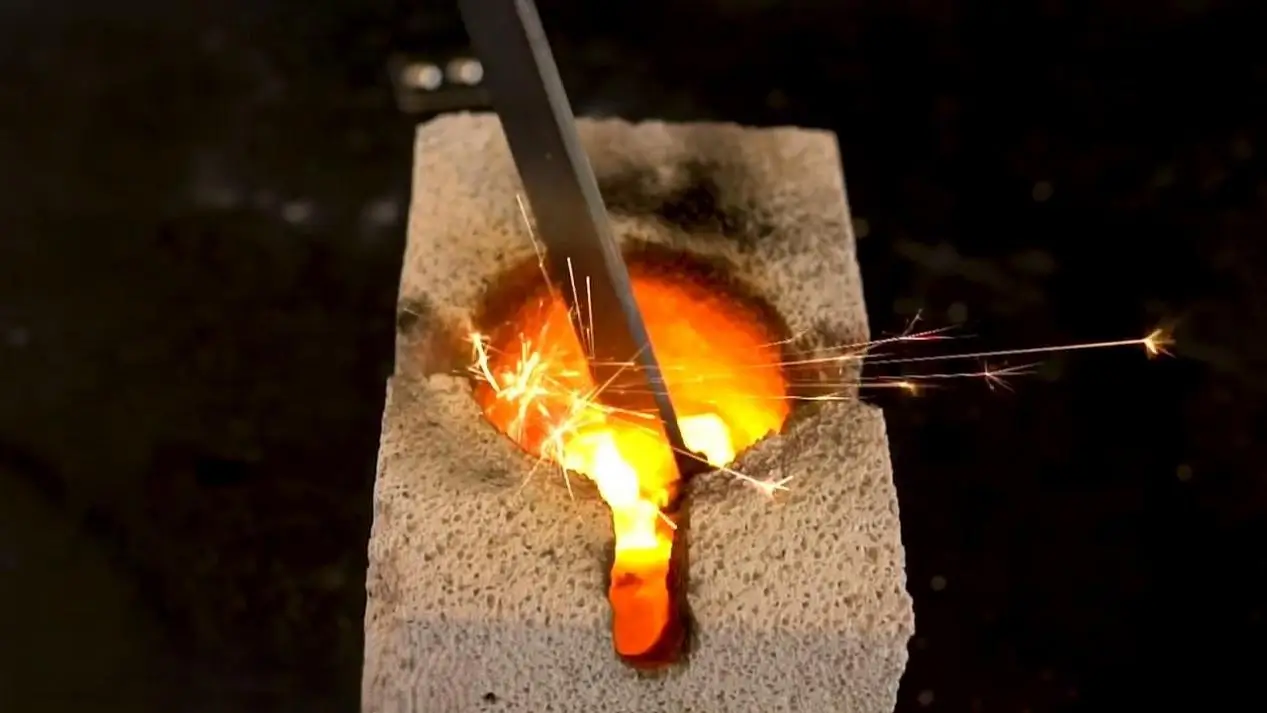
One of the most famous demonstrations in physics is heating a magnet and watching it slowly lose its magnetic strength as the temperature rises.
In basic physics classes, this happens because heat causes atoms to vibrate, which disrupts the orderly alignment of magnetic domains inside the material.However, this simple explanation leads to a deeper question that scientists still study today about how heat affects the crystal lattice inside magnetic materials.
Does the lattice change?The answer is yes, and sometimes the changes are dramatic depending on the material and the temperature involved.Heat can reshape the structure.Most materials expand when they are heated because their atoms vibrate more strongly and push farther apart from each other inside the crystal lattice.
Magnetic materials behave differently.Their physical structure, magnetic order, and atomic vibrations are strongly connected.This connection is important.Because of this link, heating a magnetic material can change not only its magnetism but also the size, shape, and symmetry of its internal lattice.The effects vary widely.
Basic Concepts: Crystal Lattices and Magnetic Behavior
To understand what happens when magnetic materials heat up, we must first look at how atoms are arranged inside solids.
In most solid metals and compounds, atoms sit in a repeating three-dimensional pattern called a crystal lattice.The smallest repeating block of this pattern is called the unit cell, and it contains all the information about how the crystal is built.It defines the structure.Each unit cell has several key measurements that describe its geometry and shape.
Scientists call these lattice parameters.These include the lengths of the three edges of the cell and the angles between them.They describe the crystal shape.
In magnetic materials, certain atoms such as iron, cobalt, nickel, or rare-earth elements carry tiny magnetic moments created by their electrons.These moments behave like tiny magnets.The distance between these atoms and the angles of their bonds control how strongly these tiny magnets interact with each other.This interaction is called exchange interaction.
What Happens When Heat Is Added
At extremely low temperatures, the spins of nearby atoms in a ferromagnetic material tend to align in the same direction.This creates a strong magnet.When heat is added, the atoms start vibrating more strongly and disturb this ordered alignment of spins.Magnetic order weakens.As temperature keeps rising, the magnetic alignment slowly breaks down until a critical point is reached.
This point is called the Curie temperature.Above the Curie temperature, the spins no longer stay aligned and instead point in random directions due to strong thermal motion.The material stops acting like a magnet.The individual atomic magnetic moments still exist, but they point randomly and cancel each other out.The net magnetism becomes zero.
How Heating Changes Magnetic Lattice Structures
When scientists study how temperature affects magnetic lattices, they find that several different physical effects can occur at the same time.
The lattice does not simply stretch.Instead, heat can change the electronic structure, magnetic order, and vibration energy inside the material.All of these interact.Because of this, the crystal lattice may expand, shrink, or even transform into a completely different structure.The result depends on the material.
Ordinary Thermal Expansion
Most solids expand when heated because atomic vibrations grow larger as temperature increases.This is normal behavior.Atoms sit in an energy well where the forces pulling them together and pushing them apart are not perfectly balanced.The potential is uneven.As vibration increases, atoms spend slightly more time farther apart than closer together.The average spacing grows.Because of this, the lattice parameters increase and the entire crystal expands.
Most materials follow this rule.Magnetic materials also experience this expansion, but magnetic interactions can sometimes change the result.
The Magnetovolume Effect
In some magnetic materials, magnetism itself strongly affects the size of the crystal lattice.This is called the magnetovolume effect.Here, the volume of the material changes depending on whether the spins inside it are aligned or disordered.Magnetism changes size.In some cases, the lattice actually contracts when heated because the loss of magnetic order removes a magnetic expansion effect.This is rare behavior.Materials that shrink when heated show what scientists call negative thermal expansion.They get smaller with heat.
The Invar Effect
A famous example of unusual thermal behavior appears in an iron-nickel alloy known as Invar.It barely expands.Unlike most metals, this alloy keeps almost the same size across a wide temperature range around room temperature.
Engineers find this useful.The reason involves changes in how electrons occupy different energy states inside the metal as temperature rises.Electrons shift positions.These changes slightly shorten the bonds between atoms and cancel the normal thermal expansion.The size stays stable.
For over a century, scientists studied this unusual effect before modern calculations explained the process in detail.It was a long mystery.
Structural Phase Transitions
Sometimes heating a magnetic material causesa much bigger change than simple expansion.The lattice can transform.During a structural phase transition, the crystal rearranges into a new geometric structure with different symmetry and atomic spacing.The structure rebuilds.
These transitions often occur suddenly and involve sharp changes in volume and entropy.They release or absorb heat.Because magnetic interactions depend on atomic spacing, a structural change almost always affects magnetism at the same time.Magnetism shifts too.
In some materials, the magnetic transition and structural change happen at the same temperature.This is called a magnetostructural transition.
Real Examples of Magnetic Materials Under Heat
Different magnetic materials respond to heat in very different ways depending on their crystal structure and electronic behavior.
Some expand normally.Others show unusual behaviors such as shrinking when heated or switching between crystal structures.A few do both.
Iron and Steel
Iron is one of the most important magnetic materials in history and is widely used in steel production.It changes structure with heat.
At room temperature, iron has a body-centered cubic crystal structure known as ferrite.This structure is magnetic.When iron reaches about 770 °C, it passes its Curie temperature and loses its ferromagnetism.The lattice stays the same.If heating continues to about 912 °C, the crystal structure changes from body-centered cubic to face-centered cubic.The structure becomes denser.This new phase is called austenite and is important in steel manufacturing.Metallurgists rely on it.
Heusler Alloys
Heusler alloys are special metal compounds that show very strong coupling between magnetism and lattice structure.They change dramatically.
Some of these alloys undergo a martensitic transformation when temperature changes.The lattice shifts shape.This process reshapes the crystal through a shear movement rather than slow atomic diffusion.It happens quickly.Because the structural change and magnetic change occur together, the material shows large changes in magnetization and electrical resistance.The properties shift sharply.
Rare-Earth Magnetic Materials
Some rare-earth compounds show even more unusual interactions between magnetism and lattice structure.The coupling is very strong.
In materials like dysprosium chromate, the crystal can expand or shrink depending on both temperature and magnetic field.Fields can control expansion.A small magnetic field can even flip the direction of thermal expansion.This shows that the lattice is not just passively responding to heat.It actively interacts with magnetism.
Magnetic Skyrmion Lattices
In some modern magnetic materials, magnetism forms patterns that behave like their own lattice structures.These are called skyrmions.A skyrmion is a swirling pattern of spins that forms a tiny magnetic vortex.It looks like a knot.
Under certain conditions, many skyrmions arrange themselves into a regular lattice pattern.The pattern can melt.When temperature rises, this skyrmion lattice gradually loses order and eventually disappears.Heat destroys the pattern.This shows that heating can affect not only atomic lattices but also magnetic superstructures.Both can change.
Engineering Uses of Magnetic Lattice Effects
The strong link between heat, magnetism, and crystal structure is not just a scientific curiosity.
It has real uses.Engineers use these effects in advanced technologies such as magnetic refrigeration, precision electronics, and high-temperature motors.Industry depends on them.
Magnetocaloric Cooling
Some magnetic materials heat up when placed in a magnetic field and cool down when the field is removed.This is the magnetocaloric effect.The effect works because magnetic alignment changes the entropy of the system.Energy shifts between spins and the lattice.Near magnetic phase transitions, this energy exchange becomes very large.Cooling becomes stronger.Scientists hope this effect can replace traditional gas-based refrigeration systems in the future.It could reduce pollution.
High-Temperature Permanent Magnets
Electric vehicles and wind turbines rely on powerful permanent magnets that must keep their strength at high temperatures.Heat is a challenge.
If the lattice expands too much, magnetic alignment weakens and the magnet loses its power.Motors lose efficiency.To solve this problem, engineers add rare-earth elements like dysprosium to strengthen the lattice and stabilize magnetic domains.The structure becomes stronger.These materials help motors operate safely above 200 °C.Durability improves.
Conclusion
Heating magnetic materials does much more than simply weaken their magnetism.It changes their structure.Thermal energy can expand the lattice, shrink it, or even transform it into a completely different crystal arrangement.Many mechanisms exist.
Magnetism and lattice structure are closely connected through interactions between atomic spins, electrons, and vibrations.They influence each other.Because of this connection, studying magnetic lattice behavior helps scientists design new materials with unique properties.Technology benefits greatly.From zero-expansion alloys to advanced refrigeration systems and electric vehicle motors, controlling these lattice changes is becoming increasingly important in modern engineering.